Amazon ad

Showing posts with label tawky tawny. Show all posts

Tuesday, July 30, 2019

Mr. Tawny Closeup!


This little article posted on Heroic Hollywood shows a closeup of those buttons/clasps/brooches/whateveryouwanttocallthem on the costume of the hero of the recent SHAZAM! movie. Between that, repeated tiger references, and one particular homeless-looking guy in a crowd scene, I am pretty confident that a talking tiger will come into play in this franchise...

The original Instagram post
https://www.instagram.com/p/B0G9WsphJ69/?utm_source=ig_embed

Mr. Tawny falls strongly into the category of "beloved" among fans of the character. He was a genial everyman, created and written by Otto Binder to represent himself and his concerns and struggles (you can find out more about this in The Fawcett Companion and Bill Schelly's biography of the writer, Words of Wonder). He was loyal and true to his friends, Billy Batson and Captain Marvel and excelled in his job as a tour guide in the local natural history museum.

Despite this, he would often seek something more, something new, something different in life. He would bemoan his boring, everyday life and fall for a get-rich-quick scheme, or try to recapture his lost youth, or gain everlasting fame or great popularity, or attempt to return to the free life of an animal in the wild.

In teh end of each of these comedic adventures, however, he would find that just being himself, a regular guy, was what was best in life and most satisfying for him.

These stories were sopme opf the best-written in the Fawcett run of Captain Marvel and the Marvel Family. the love for the character form the writer was clear, and artist C.C,. beck was at the top of his game. Gwuandanaland recently published a collection fo all of hi sstories, including the very best  C

I made mention of Mr. Tawny references in the movie in my on-the-spot review. In case you missed it, here it is...

Den of Geek has made mention of these disks and their tiger faces, also making the Mr. Tawny connection as part of a pretty thorough rundown on the suit that was designed for the movie.


And on page 2 of this ScreenRant article, the designer himself talks about the tiger imagery on the suit.


Personally, I think that Mr. Tawny is going to turn out to be that homeless-looking bearded guy who was oddly prominent in two shots of the crowd during the "caught the bus" scene. This would be consistent with Jeff Smith's  interpretation in "Monster Society" and the Superman & SHAZAM! vs. Black Adam animated short film.

What do you think?

Monday, June 17, 2019

POWER of SHAZAM! and the history of ALL the Captain Marvels (Part 14)

Note: This page is continually being updated. Please feel free to revisit to see updates as more information and images get added to this entry.

In the early 1990's DC wagged its tail to the speculator market no less than Marvel. Although they did not have an exodus of artists like Marvel, they still needed to do something to remain relevant. Thus came The Death of Superman.

As we saw in the last chapter, the 1993 Death of Superman saga at DC was the high-water mark of the speculator's market and the comics industry serving it. As we also saw in Part 11 of this history, DC had combined all of its multiple "universes" into one through the Crisis on Infinite Earths in the 1980's. As the 1990's approached the midway point, both of these events were showing their downsides. The speculator's market bubble burst, leading to a precipitous decline in sales across the board, and inherent contradictions and unsettled character histories revealed weaknesses in the continuity of the new DC universe.

In an apparently unrelated move, the SHAZAM! franchise was revived.

DC's version of the original Captain Marvel, now (as of Part 12 of this history), the version created by Roy Thomas in SHAZAM! The New Beginning, had not been seen much since that 1986 mini-series. John Byrne proposed a version, wrote a story, and even drew a couple of pages, but that project never saw fruition. The Big Red Cheese did make big appearances; in 1991, as part of the War of the Gods miniseries, and in 1992, battling a Superman possessed by the villain Eclipso.


But while all this was happening, in 1991 Jerry Ordway was asked (according to his introduction in the most recent reprint volume of DC's initial revival of Captain Marvel and the Marvel Family) to "relaunch the SHAZAM! characters." He researched the DC revival, the Fawcett comics, and even the Republic Pictures' Adventures of Captain Marvel serial. In 1994, his new graphic novel, The Power of SHAZAM! was released.
  

This gloriously drawn and painted, this new production was a loving tribute to the character and its history, but made certain drastic departures from the original stories.


In this story, Billy's parents, C.C. and Marilyn Beck, were archaeologists murdered during a dig in Egypt by Theo Adam, in the employ of Thaddeus Sivana, the wealthy industrialist who financed the mission. Billy wound up selling papers and living on the street when he was taken to the wizard Shazam by a stranger through a subway tunnel. Once he got his powers, though, he hated them. They were confusing and he lacked the maturity and experience to use them properly.

(And yes, this was where the recent movie got the names of Billy's parents.)

The "McGuffin" of the story, a scarab necklace on an ancient mummy, gave Theo Adam the power to transform into Black Adam, and it turned out that he was really the ancient villain reincarnated. He quit Sivana's employ, Sivana's financial empire and plans and schemes crumbled, Billy adapted to being Captain Marvel and defeated Black Adam, and the stranger who had led Billy to the old wizard turned out to be the spirit of his dead father.

But this was a different Captain Marvel. Set in a more realistic world where a 10-year-old boy living on his own would be snatched up by civil authorities, Billy Batson had to figure out how to survive, and turned out to be a scrappy, self-reliant survivor.

Jerry Ordway established Fawcett City as the home of Billy Batson/Captain Marvel (after Roy Thomas had created it for a story in All Star Squadron about ten years earlier) and made the city one that retained the modernist Art Deco style of the 1930's. This and other elements were blatant tributes to the Fawcett stories and the work of the writers, artists, and editors of those days. Streets were named after Fawcett-era writer Otto Binder and artist C.C. Beck, Billy's father was named after Beck, a scene of Captain Marvel throwing a car against a wall was an obvious tribute to the cover of Whiz Comics #2, and the subway tunnel, train car, and throne room of the old wizard were adapted very faithfully (with some detailization) from the original story.

The book was a big hit, critically and commercially, and led to a new series of the same title.

But before that new series began, in September 1994, DC began a new, company-wide, crossover epic miniseries, Zero Hour. It seems that the Crisis on Infinite Earths series of 1986 had set up a bunch of contradictions and failed to resolve certain matters in the DC Universe, so Zero Hour was an attempt to fix it.


As a result, a new DC Universe was established, mostly similar to the previous one, but it was assumed by most who cared that this re-invention of Captain Marvel was to belong to this post-Zero Hour world.

And thus did the new Power of SHAZAM! ongoing series begin in 1995. Set a few years after the graphic novel, Billy had his job at WHIZ broadcasting and was attending school. The school janitor, Mr. Dudley, helped the boy out where he could. Billy's uncle, Ebenezer Batson, had thrown him out on the street. In his Captain Marvel form, Billy would sometimes disguise himself to act as his own uncle or get work on the side.

The wizard Shazam played a much more integral part in the stories than he had in the Fawcett and pre-Crisis DC stories. It was revealed that his throne room was in the Rock of Eternity which was reached through a dimensional barrier. The old wizard had cast a spell on Fawcett City to make time pass more slowly and protect it from certain dangers, thus ensuring it kept it's Art Deco look and 1930's-'40's styles and cars all the way to the end of the 20th century.

Theo Adam/Black Adam was a regular adversary of the Marvel Family through the series. Eventually the Theo Adam personality was completely subsumed by Black Adam, to the point where his alter ego was his ancient self - Teth Adam.


The series started with both Billy and the wizard looking for Billy's sister Mary, and found that she had been adopted by the wealthy Bromfields, Nick and Nora (obviously based on the comedy-detective duo from the 1930's "Thin Man" series of films).

Mr. Tawny, the talking tiger from the Fawcett/DC comics, turned up as a "pookah," a Celtic shape-changing spirit who appeared to most everyone as a stuffed tiger doll, but to Billy and Mary was a full-size, anthropomorphic tiger. He guided Mary to say the magic word, granting her powers, but instead of calling herself "Mary Marvel," she called herself "Captain Marvel," so now there were two Captain Marvels.
 

Freddy Freeman was a recurring character as well, a star high school athlete and Big Man On Campus, but near-death injury resulting from Billy/CM's battle with Captain Nazi led to him being orphaned and granted the power to become Captain Marvel, Jr. by saying that "Captain Marvel." Because of the difficulty in introducing himself without transforming, he eventually chose to call himself "CM3."
  

CM3 at first had a crush on Mary, but it didn't go over well with Billy, so the third Marvel left town, joined the Teen Titans, and later the more edgy Outsiders.


The wizard Shazam involved himself directly in the lives of the Marvel Family, breaking up arguments and guiding them to important tasks. At one point he left the Rock of Eternity to explore life on Earth again, often comparing life today with that of the 1930's and '40's, a period of which he was fond, hence the magic spell he had cast over Fawcett City.

One unique detail regarding the powers of the Marvel Family in this version was that they were limited. When two or more of them were in their "Marvel" identity, that limited power was shared. So each of them became less powerful, less invulnerable. Black Adam was even able to break Billy/CM's arm under such circumstances. This limitation, however, was eventually eliminated when Ibis upgraded their powers while covering the old Wizard's position at the Rock of Eternity.

The wizard Shazam was brought into DC's magical realms, including the afterlife, and a couple of supernatural Superman villains, Blaze and Satanus, were revealed to be his children. The old wizard even advanced to godhood before the series was over (in the polytheist, mythological, Jack Kirby's New Gods style).

Mr. Tawny, it turned out, had been a stuffed animal all along, but given the opportunity to be "real" by Blaze, if he did her bidding. When Blaze was defeated, Ibis gave him the option of remaining a real, anthropomorphic, talking tiger. He jumped at the chance, and became a recurring character in the DC universe.

The series, like the graphic novel, had a lot of references to the Fawcett years. Street names, businesses, and characters were named after writers, artists and editors from Fawcett. Obscure characters like "Muscles" McGinnis made appearances, as well as old Fawcett heroes like Ibis the Invincible and his companion Taia, Bulletman and Bulletgirl, Mr. Scarlet (actually his old sidekick Pinky bearing his former mentor's identity), Spy Smasher, Minute Man, and Lance O'Casey.

Villains from the Fawcett stories that appeared included Ibac, Mr. Mind, Mr. Atom, and the Arson Fiend.

The series lasted for 47 issues (with one extra "One Million" issue as part of a company-wide crossover event that some count as the 48th). In it Ordway was able to explore the awkwardnesses of Billy trying to get along in adult society as a superhero although he was a teenage boy. He eventually got adopted by the Bromfields and they were able to live together as a family.

Additional Shazam-powered characters, some named "Captain Marvel," some not, were created in this series: C.C. and Marilyn Batson were Captain Marvels in an alternate timeline created by Sivana (now refered to as "Dr. Sivana.")
       
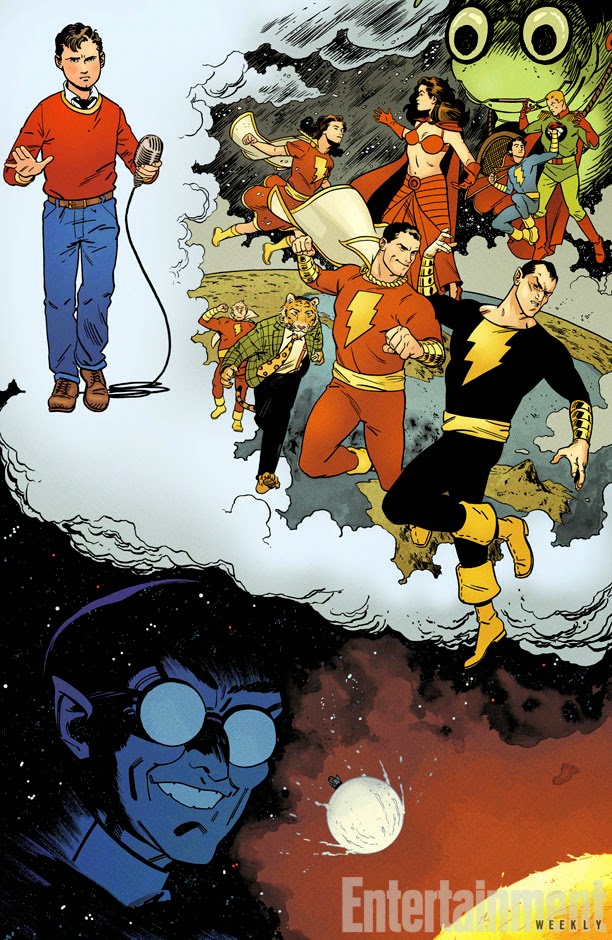
This three-part story also featured a great full-page illustration that interpreted several Captain Marvels in SHAZAM! style! (Note also the letters embedded under the golden man's arms!)

In Power of SHAZAM! One Million, the hero was a young man on the planet Mercury named Tanist, granted the power by an aged Billy Batson/Captain Marvel in the far future.
  

In the 1996 Power of SHAZAM! Annual, the hero was Cecebeck, who took the name "Thunder" when superpowered. She would later join the Legion of Super-Heroes.
  

DC had created a line of books under the imprint "Elseworlds," in which the heroes were put into alternate histories, contexts and situations. In Elseworld's Finest: Supergirl & Batgirl #1 (September, 1998) there was a Captain Marvel in the Justice Society. This was the first black Captain Marvel to see print in DC.
 

During this time, Captain Marvel made significant appearances in miniseries like Kingdom Come and Underworld Unleashed. When used to best effect, Billy Batson's humanity, youth, and purity of heart were deciding factors in the outcomes of the stories.


During this time the Big Red Cheese shared stories with many DC heroes, both as guests in their books and with them as guests in his, including Superman, Batman, the Flash, Green Lantern, Plastic Man, Starman, and even this old favorite...

The series was highly regarded critically and sold well, but not well enough to avoid being cancelled just shy of its 50th issue (which disappointed Ordway). The final issue had a cover that was directly inspired by the cover of the final issue of DC's first SHAZAM! series:
    

 But though this series did not last out the decade, this Captain Marvel remained a major player in the DC universe...

Next for the DC Marvels: Society, Leagues, and crises, crises, crises!
For the Marvel Marvels: Genis-Vell cracks up! and Marvels, Marvels everywhere!


Wednesday, May 1, 2019

SHAZAM's WORLD'S FINEST CRISIS! (History of ALL Captain Marvels Part 11)

Back in Part 5 we saw how DC licensed the original Captain Marvel and the Marvel Family from the still-extant Fawcett Publications. When last we left our hero, his book had been cancelled right at the start of the "DC Implosion" and he had been relegated to the back of World's Finest, a "DC Dollar" anthology book.

In those pages Don Newton did the art and E. Nelson Bridwell wrote the stories under the editing of Jack C. Harris. Many parts of Marvel Family canon were explored.

It was revealed that the wizard Shazam had been a superhero named "Champion" thousands of years ago, with his own fictional "proto-semitic" pantheon that gave him powers when he spoke the magic word "Vlarem!" (unscramble that to find out where World's Mightiest Mortal got his name). Together, he and Captain Marvel put the Rock of Eternity into its place.


Freddy Freeman found that he was actually the brother of Christopher "Kit" Freeman a.k.a. Kid Eternity, a young hero from Quality Comics who had been acquired by DC and rolled into the Marvel Family's universe. Interestingly, Kid Eternity had been created by Otto Binder, the prolific writer who had written more than half the stories of Marvel Family characters for Fawcett.

Mr. Tawny discovered that the serum that gave him the ability to speak had also slowly transformed him physiologically until he was so human-like, it was difficult to walk like a tiger.


The "power of Zeus," long undefined (except in that he was the one who delivered the transformational lightning), was revealed to be an augmentation of the powers of the all the elders (wisdom, strength, stamina, etc), thus enabling certain abilities that were not strictly the named powers, such as flight and invulnerability.

Even the brocade on the capes of the Marvel family was brought into play, as someone mentioned that "moley" (As in Billy Batson's frequently-used expression "holy moley") was a plant with "little yellow flowers."

Eventually, DC cancelled its DC Dollar Comics line. SHAZAM! stories continued as a backup feature in Adventure Comics for a while, then in April, 1985, DC began their Crisis on Infinite Earths "12-Issue Maxi-Series." The object of this was to "simplify" the DC Universe.


Here is a little backstory on the original DC Multiverse:

DC's original cast of superheroes had mostly ceased publication by the 1950's. As we have seen,  in 1956 the Flash was re-invented with a new costume, a new alter ego, and a new "secret origin." He was such a hit that DC decided to reboot its entire superhero line. They would keep some characters largely the same (Superman, Batman, Wonder Woman), alter the costumes, powers, origins, and alter egos of others (The Flash, Green Lantern, the Atom, Red Tornado), create some brand new heroes (Martian Manhunter, Adam Strange, Captain Comet). A couple of heroes who had already existed (Green Arrow and Aquaman) continued to exist largely unchanged with these new and newly-interpreted heroes. This world continued as the main superhero world of which stories were told in DC Comics.

But what happened to the original heroes, including the ones who were not re-booted or re-invented, like Dr. Fate, Hourman, Mr. Terrific, Wildcat, and Johnny Thunder? It turned out that they still existed, along with their pre-reboot comrades, but in an alternate universe existing on a different "vibratory plane." This was discovered by the new Flash (Barry Allen) when he traveled to the world of the original Flash (Jay Garrick). Because the new Flash had discovered the world of the old one, his world was called "Earth-1" and the one with the older heroes was called "Earth-2." This world appeared from time to time in special stories uniting the Justice Society of America (The original DC superhero team) and the Justice League of America (the new superhero team).

It was later revealed that there was an "Earth-3," whose versions of superheroes were really super-villains, Supeman being called "Ultraman," Wonder Woman "Superwoman," and Batman "Owlman," for instance.

When DC acquired the superhero characters of Quality Comics (Uncle Sam, Black Condor, the Ray, Doll Man, Phantom Lady, Human Bomb, etc) they placed them on "Earth-X," a world where the Nazis won World War II.

So when DC revived Captain Marvel and the Marvel Family, they put them on their own world Earth-S (for SHAZAM!).

Our world (in which the writers and artists of DC Comics created all these stories) was even a part  of this "multiverse," known as "Earth Prime."

By 1985, the folks at DC decided that having all all these worlds was confusing to the readers, hence Crisis. The story was a massive, sprawling epic that crossed over into almost every DC comic book. By the time it was all done, all the worlds in the multiverse (including a brand new one on which the recently acquired superheroes from Charlton Comics, Blue Beetle, The Question, Peacemaker, Judo Master, Captain Atom, etc, resided) were merged into one. The fictional history of these characters was re-written. Superman, Batman, Wonder Woman, and most of the characters of Earths 1, X, and S, and the Charlton heroes, began their careers contemporaneously in the present day. The original superheroes of Earth 2 began their careers in the 1930's and '40's, corresponding with their original creations. DC's "Trinity," however (Superman, Batman, and Wonder Woman) began their careers in the modern day, and were retconned to not have existed in the early days, and their origins were re-written with a few tweaks here and there.


So, with this new, combined universe, the Big Red Cheese was given an all-new origin story...

NEXT: The New Beginning!


Thursday, May 28, 2015

"Shazam" Convergence Review, part 1

After having been out of the comic book market for a month and a half due to my trip to the medieval combat world championships (my documentary of the USA Knights is coming soon) so I finally got a chance to catch up on the whole "Convergence" thing happening with DC Comics and the role of the original Captain Marvel in it.

It started, if you will, with the "Multiversity" event, a storyline in which the different universes of the "New 52" were explored, some being developments of "Elseworlds" concepts from years ago, some being brand new interpretations of DC characters and superhero tropes, and one being a new interpretation of the classic hero and his word from Fawcett Comics.

As regular readers of this blog know, the original Captain Marvel was acquired by DC Comics in 1972 and his stories began pretty much where they left off, with an explanation of how the Big Red Cheese, Junior, Mary, the Sivanas, and most of the other back-up characters had been trapped in a vessel of "suspendium" for 20 years. DC also explained that these characters existed on "Earth S," a parallel Earth in which the regular DC characters did not exist. After the "Crisis on Infinite Earths" of 1986, all the alternate universes were combined into one, and some major characters, including the Big Red Cheese, were "rebooted" and given slightly different interpretations.

Then the New 52 hit in 2012, and DC rebooted their entire universe and every character in it. They established that there are 52 alternate universes and implied that there was an "Earth 5" that appeared to be a copy of Earth S (5 = S, get it?).  It was stated publicly, however, that Earth 5 was not Earth S and that we would find out, someday, what it was.

What it was was revealed in the Multiversity one-shot "Thunderworld." This was a fun, entertaining romp written by Grant Morrison and drawn by Cameron Stewart that introduced the world of Earth 5, in which the Marvel Family, with the help of Tawny, Uncle, and the Lieutenant Marvels defended Fawcett City from the Sivana Family and the Monster Society, as Dr. Sivana captured the Rock of Eternity and stole enough suspendium with the help of alternate-universe Sivanas to create an 8th day of the week. It was a brilliant combination of the hokey ficto-science and adventure of the classic Fawcett stories with multi-cosmic and, frankly, disturbing elements of Multiverse.


In "Thunderworld," the re-interpretations of certain classic elements (The Lieutenant Marvels now included Uncle and Tawny and were a uniformed, rocket-packed, sci-fi-weapon-bearing squadron, and Billy used a cell phone with his updated backpack broadcasting equipment) were handled lightly and not out of character with what one might expect from an organic progression of the characters from the 1940's. Dr. Sivana's motivations were consistent with the character, making him the perfect character to begin to explore the evil implications of a multiverse. The conclusion gave us a perfectly satisfactory twist and a closing that was consistent with anything Otto Binder ever wrote. The whole story was applauded by the great majority of fans of the World's Mightiest Mortal, and we all wanted to see more.


So when "Convergence" was announced, we waited with bated breath to see how it would turn out...

Thursday, January 15, 2015

Original "Shazam!" Captain Marvel Converges with Gotham by Gaslight!


DC Comics has just announced an appearance of the "Earth S" Captain Marvel, the original from Fawcett publications 1940-1953 and DC Comics 1973-1986.

This will come as part of the "DC Convergence" event in which many of the universes created by DC Comics, including those of characters from other comics companies that DC has acquired, the alternate universes that explained the difference between "Golden Age" and "Silver Age" characters, the post "Crisis on Infinite Earths" universe, their many "Elsewords" universes, and the "New 52." I week 4, there will be ten titles released, each of which involves the crossover of two universes. Of interest to this blog is the title "Shazam!"

In this issue, the original Captain Marvel will crossover with the world of "Gotham by Gaslight," a gothic/steampunk word of a late Victorian era Batman.

This is not completely out of the realm of something that the Big Red Cheese would do. Many times in the Fawcett years did the hero, and many times Mary and Junior too, travel through time. The contrast of the "sunny" Captain Marvel with the dark, brooding Batman should prove to be an interesting combination, and if the preview art is to be believed, it looks like we will be seeing the rest of the Marvel Family as well as Mr. Tawny, and favorite villains like Black Adam, Mr. Mind, Captain Nazi, and Dr. Sivana. There is also one female villain that I don't recognize. Am I missing her from my knowledge of the original Fawcett universe, or is DC creating a new villain for this story?

The preview listing is the eighth title down on this page...
http://www.newsarama.com/22861-dc-s-convergence-week-four-pre-crisis-multiverse-is-back-baby.html

Friday, July 11, 2008

Mr. Tawny, the Feline Everyman

While many of Captain Marvel's adventures could be seen simply as fun adventures, there were times when moral lessons were imparted. These were frequently through the use of a very popular character, Mr. Tawky Tawny, the talking tiger.

Mr. Tawny was the everyman. A tiger from a non-specified jungle on another continent, he had been given a serum which enabled him to speak and think like a human. His curiosity of the big city brought him to America, where he did his level best to fit in. He would face those common challenges that we all have faced in our lives. He would struggle with his weight. At times he would fall prey to get-rich-quick schemes or “personality potions” or other gimmicks that he thought would make him more popular. But the most serious challenge came when he tried to get a new house.

Published in 1947, “Mr. Tawny's New Home” came out right when both pro football and big-league baseball were breaking their color barriers. Black people had come home from WWII proving that they could do anything whites could do, and the march towards the end of Jim Crow was beginning. But prejudice dies hard, and hate groups like the Ku Klux Klan still existed. This story had Mr. Tawny moving into a new neighborhood, where it turned out the people feared and distrusted him. They even formed a citizens group to drive him out, complete with robes, masks, torches, and pointy hoods.

Captain Marvel stopped their rampage, and Mr. Tawny proved himself to be a good fellow, and so the community learned something about tolerance and acceptance. This was a lesson Captain Marvel taught in several other stories as well. But this valid and important point was inadvertently undercut by some other things that had appeared earlier in the pages of Captain Marvel comics.

Early on, Fawcett had decided to try to appeal to a black audience, so Ed Herron created the character of Steamboat. Steamboat was a hot dog salesman who became Billy Batson's valet at station WHIZ. He spoke in a stereotypical “Negro” dialect, was nobly loyal to his boss, and had big red lips that took over half his face. In short, he was a demeaning racial stereotype.

But such stereotypes were the norm for popular entertainment at that time. Steppin Fetchit was the most popular (and wealthiest) black actor in mainstream Hollywood. One could still find blackface minstrels in the movies, with nothing thought bad of it. This even had a tradition within Fawcett Publications history; Captain Billy's Whiz Bang was notorious for its off-color and racial jokes. It is sad, really, that in an attempt to appeal to a specific audience, they wound up creating a character that described everything that that audience found offensive. The character was discontinued after a delegation from the black community marched into the Fawcett offices and demanded it.

Perhaps it is easier for people to swallow a moral lesson if they can see it as a parable, rather tan seeing the story in its unvarnished truth. Perhaps by seeing a real black person, prejudiced people would be blocked from the lesson by their prejudices. But Mr. Tawny was an already popular and beloved character (a mail-in contest to give him his first name drew thousands of responses), so using him to highling social issue must have seemed more effective.

Next: Captain Marvel Goes Hollywood!