Here is the third part of my 3-part review of "The Marvels," focusing on the costumes and charcter names, revealing some Easter Eggs and other details that may fascinate you!
When last we left Carol Danvers, it was 1982, and she had just gained the power of a "white hole" (a theoretical astronomical phenomenon that must be the opposite of a "black hole") and became the superhero "Binary" while in outer space with the X-Men.
First appearance of Carol Danvers as Binary.
She returned to Earth where, with the help of Professor Xavier, she regained most of her memories, and started to regain her Ms. Marvel powers.
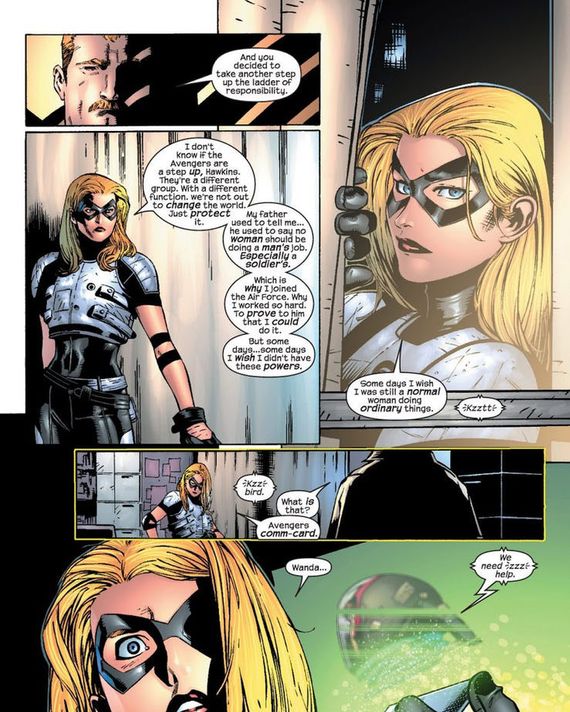
In 1998, she rejoined the Avengers, went back to her second costume (the black leotard with the lightning bolt), and started to lose her Binary powers. She changed her superhero name to "Warbird," became an alcoholic, and was court-martialed out of the Avengers.
Carol Danvers picking her name with a little help (Avengers #4)
Carol Danvers explaining why she turned to drink (Iron Man #7)
Carol Danvers' court martial not going well (Avengers #7)
Carol Danvers getting the wake-up call. (Avengers #7)
She then recovered from her alcoholism and joined S.H.I.E.L.D, switching to a more militarily-practical costume with utility pockets and an armored vest.
She eventually returned to the Avengers, redeeming herself and regaining her status with the team.
In 2005, Marvel Comics' big company-wide, history-changing crossover event was "House of M," an alternate reality created by the mentally unstable Scarlet Witch in which mutants had become the dominant species. In this world, her friend Carol Danvers was Captain Marvel, who, despite being of human birth, was the greatest hero in the world. In short, she was this reality's Superman.
When the storyline concluded and reality was shifted back to normal, she remembered what it felt like to be that successful, confident, and popular. She liked it, and felt that if she could be that there, she could try to be that here, too. She changed her superhero name back to Ms. Marvel, got a publicity agent, and struggled to fight threats cosmic and terrestrial.
In the 2006-7 company-wide crossover event "Civil War," she sided with the government, supporting superhero registration, despite an appeal from Captain America.
It was during this last event that a return apparently occurred. Captain Mar-Vell.
The person who seemed to be the once-dead hero appeared through what appeared to be a hole in time, and he had come to the present day from before he died. He was given the assignment of guarding the orbital prison for unregistered superheroes while he wallowed in melancholy about why he was in a future in which he was dead.
More on this in the next chapter...
Some of the titles in which these stories can be found are taken from a very thorough list about
Before we get too far away from the 20th century, there is one short-lived Captain Marvel and several related characters we should mention for the intriguing possibilities of these characters as well as the groundbreaking means by which they were created.
By 1995, the comic book boom had pretty much busted. The excitement engendered by the birth of Image and Valiant Comics, the Death of Superman, and the reveal of the new Batman after Bane broke Bruce Wayne's back had run its course. Sales were dropping, comic book shops were closing, and independent companies were dying off.
Marvel Comics itself, having been acquired by Ronald O. Perelman in 1989, went public that same year, spent hundreds of millions of dollars under Perelmen buying up or into companies that produced toys, stickers, trading cards, and other comic books, and a distribution company, and by 1995 found themselves under mountains of debt.
Since the success of Marvel's Contest of Champions, and Secret Wars, and DC's Crisis on Infinite Earths, company-wide crossover events had become the go-to attempted circulation boosters for both Marvel and DC. Furthermore, comics fandom was always a-chatter with theories and speculation on what would happen if superheroes from the two big rival companies were ever to meet.
With this no doubt in mind, DC and Marvel got together and launched DC Versus Marvel, a crossover between both companies! In this 1996 4-issue miniseries, (with one "#0" free preview giveaway issue), fights were staged between comparable characters of the two companies.. This included Superman vs. The Hulk, Batman vs. Captain America, Aquaman vs. the Sub-Mariner, Wonder Woman vs. Storm, and Captain Marvel vs. Thor. (Marvel Comics' Captain Marvel, still technically Monica Rambeau, only appeared n one panel, and Genis-Vell, the all-but-official inheritor of the title whose comic had recently been cancelled did not appear at all).
There was an extra gimmick to this series, though, that did engender greater reader interest, and that was that for the matches between the bigger names of each company, the winners would be decided by reader vote! For better or worse, however, Captain Marvel vs. Thor was not one of those matches.
I suppose this was as logical a matchup as one could imagine. Both of them being of godly power and with a lightning and thunder theme. And though they threw in a one-panel gag that acknowledged how one character was a rip-off of the other, DC's Snapper Carr and Marvel's Rick Jones razzed each other.
The fight was won by Thor in a conclusion some Captain Marvel fans felt unsatisfying. But that was not the last appearance of a Captain Marvel in the DC-Marvel co-production.
The story that contained these battles was extended to bring the two universes, Marvel's and DC's, together in an amalgam not just of the worlds, but of the characters and the companies. Superman and Captain America became "Super Soldier," Batman and Wolverine became "Dark Claw," Wonder Woman and Storm became "Wonder Woman," but looked like Storm in a mashup of her and Wonder Woman's costume, and Captain Marvel and Captain Marvel became..."Captain Marvel."
The conceit of the concept was that it was a line of comics called "Amalgam Comics," and that these "amalgamated" heroes had been around all along, in place of the ones with which we were familiar. There were backstories and publishing histories of each character with made-up titles of comics combining titles of existing comics. Captain Marvel fit into this paradigm easily.
Though only seen briefly in two published comic books and a few trading cards, he had a secret identity and backstory. His alter ego was young Billy Mar-Vell, who upon saying the alien word "Kree!" would "super-scientifically" transform into Captain Marvel, with a white suit, green gloves, boots, briefs, and yoke, and green lightning bolt logo on chest. He had powers of super-strength, super-speed, invulnerability, and flight.
As he was only one of a bunch of heroes in "Judgement League: Avengers," he didn't get much to say or do, but he did express disdain and distrust of aliens and "metamutants." This disappointed me, as all other Captain Marvels had actively fought against prejudice in some form or another.
The fictional history of this character included him first appearing in "Whiz Marvels #1," being a founding member of the "Judgement League: Avengers" and present in the "Secret Crisis of the Infinity Hour" (a crossover epic that was never really published, but key story points were related in a series of trading cards. the title referenced Marvel's Secret Wars, DC's Crisis on Infinite Earths, the series of Infinity War-related stories from Marvel, and DC's Zero Hour) when "American Girl" (a pastiche of Ms. Marvel and Supergirl named "Carol Barnes," a combination of Carol Danvers and Bucky Barnes) sacrificed herself to save the universe.
For her part, "American Girl" was a successor to "Super Soldier," the living legend of WWII, and his fellow hero, "American Belle" (herself a pastiche of Marvel's Miss America and DC's Liberty Belle).
And speaking of Carol Danvers, a character by that name was the alter-ego of Amalgam's "Huntress," a former US secret agent super-spy with a crossbow (an amalgam of DC's Huntress and Marvel's Hawkeye, along with elements of Carol Danvers' Marvel Comics history) who filled a sort of "Batwoman" role to Dark Claw.
Rick Jones was not left out of this. He appeared in an amalgam with his DC counterpart/inspiration, "Snapper" Carr, as Snapper Jones, a.k.a. "Bismouth," a member of "Magneto's Magnetic Men" who appeared in an eponymous comic. He was super villain, an amalgam of Tin, a member of DC's Metal Men, and Toad, a member of Marvel's Brotherhood of Evil Mutants.
Apparently, he was created by Magneto, killed, revived, gained sentience, told to live a human life, and became a street musician.
(Incidentally a Steve "Snapper" Jones was a star basketball player in the American Basketball Association who became a popular broadcast announcer)
Another miniseries involving the Amalgams came out in 1997, titled Unlimited Access. In it, the character of "Access," a normal Earth Human who wound up with the power to amalgamate characters from the DC and Marvel universes, created more of these amalgams, only some of them with less apparent relevance between the component characters.
The Captain Marvel-related character here was "Captain America, Jr," (appearing in Unlimited Access #4) whose alter ego, Freddy Rogers, could transform into his hero by shouting "Uncle Sam!" His powers appeared to be based on characteristics of United States presidents, including the strategy of Eisenhower and the trickery of Nixon. He only appeared in this one issue.
Since this, fans have created a myriad of mashups of superheroes, including several involving one or another or several Captain Marvels. Marvel itself, in NextWave: Agents of H.A.T.E.created a mashup of Monica Rambeau and Mar-Vell that was brilliant in its execution.
But I feel that the Amalgam missed an opportunity here. The original Captain Marvel is one of the all-time great superheroes. He managed to capture an audience at just the right time that wanted to see a hero exactly like him and outsold Superman. His paradigm, the mortal, particularly a child, who could transform by magic into a hero, was the template for many other superheroes, both seriously within the industry and as a trope in everything from advertising to satire.
Furthermore, Marvel's first Captain Marvel was a hero with depth and dimension. He had an uneasy history of persecution and struggle. He even died! Combining this backstory with the sunny, optimistic, eternally-young Billy Batson-Captain Marvel would have been a fascinating challenge.
Amalgamating Billy Batson and Rick Jones would have been interesting. Billy Batson was a radio and TV reporter, Rick Jones a musician. Billy had a youthful fan club, Rick had his "Teen Brigade." Rick Jones was the sidekick of several superheroes over the years. I might have been interesting to have that his backstory be of a young journalism student with musical talent who winds up sickicking for several superheroes before meeting the old wizard Perhaps the boy's experience as a sidekick, his journalistic integrity, and his musical soul would have been a factor the wizard considered in selecting him to be his new champion. And now, as a superhero, it is that experience which informs him in how to use his powers to fight crime, evil and injustice.
Here is where the contest comes in, folks! Design and draw the above mashup of Billy Batson with rick Jones and Captain Marvel with Captain Mar-Vell and post it in the comments below. We will then have a contest where readers an vote on their favorites. The winner will receive a free copy of my three-pamphlet series "Captain Marvel Culture."! :)
On top of all this, there was the cosmic power thing. Mar-Vell gained "cosmic awareness" from the entity Eon, granting him the ability to be universally omniscient. He was aware of all things in the universe. The wizard Shazam resided in the Rock of Eternity, at the nexus of all universes, and from there knew all things. Perhaps some bizarre partnership or mashup-of these two mentor-like figures who granted powers to their heroic proteges could have been explored in this series!
And finally, the big red elephant in the room: Both companies had Captain Marvels, but the original one could not have his name in the title, even though three other companies had plastered that name all over their covers! It would have been a fine and fitting tribute to the legacy of Parker, Beck, Binder, Schaffenberger, Lee, Colan, Thomas, Kane, Starlin, Gruenwald, Milgrom, Broderick, et al, a symbol of camaraderie between the two companies, and simply, ridiculously appropriate for Amalgam Comics to publish a Captain Marvel comic book.
And with regards to Monica Rambeau, perhaps she could have amalgamated with the light-based DC superhero The Ray to become "Lightray" or something...
Another short break from the ongoing saga of the many Captain Marvels to cover this rather important movie in superhero cinema history...
Frack you all, you anti-SJW push-backers, claiming that the two most recent Marvel movies would be feminist propaganda! Frack you, those complaining that Carol Danvers/Captain Marvel being the strongest hero in the Marvel Universe would turn her into a Mary Sue and disrespected the God of Thunder. Frack you all for making me have that in my mind as I was experiencing the awesomeness that is Avengers: Endgame!
Frack you all, also, who claim the the movie is just a big pile of contrived fan service. I did not go to the movies tonight to NOT see every hero in the MCU get a well-deserved moment on screen!
The message of the movie is what the Avengers movies have all been about: teamwork and sacrifice. It is about working together to succeed at an objective. It is about finding the right place for each member of a team according to their abilities. It is about being willing to sacrifice everything and fight to the end if you believe in the objective for which your team is fighting. That is the awesomeness that is Avengers: Endgame!
Now some elaboration...
For months, now, folks at Marvel were saying that Carol Danvers/Captain Marvel was going to be the most powerful hero in the Marvel Cinematic Universe. "But what about Thor!?! You are disrespecting him!!!" was the plaintive cry of those who are "sick and tired of all this SJW nonsense in comic books." and claim that the push for "diversity" is killing comics; the "Carl Manvers" haters and Brie Larsen detractors who take offense at being told that a certain movie was not made for "40-year-old white dudes" and just can't get enough of that shot of Don Cheadle pulling away from Brie in that TV interview.
Here is a wake up call and analysis of the MCU and this movie and how Carol Danvers/Captain Marvel fits into it:
The MCU needed a Superman. Thor is not a Superman, because he is too flawed. He had been a flawed character from the beginning, and his journey has been one of self-discovery. Growing up he was so strong and so mighty in a culture that valued being strong and mighty that he could do no wrong. But from his very first movie on, the way to make something a challenge for him was to get him to fall victim to his pride and doubt himself. By the time the story truly begins in A:E, he has truly lost all his mojo because he failed, big time. It was perfectly within his character for him to react that way, and that made him more human, more entertaining, and his recovery more heroic. His heroic story arc is about earning his power by learning humility and overcoming depression.
Carol Danvers' story arc is about realizing her power in a culture that does not value women for being strong and mighty, and her independence in a culture that is subservient to the will of an authoritarian dictatorship. Her knock-downs are not blows to her pride, but rather challenges to her might. For dramatic satisfaction, the Superman that this movie needed needed had to be one that was a surprise to Thanos and a surprise to the audience. Who'da thunk that out of nowhere, from the far corner of the universe, would come a woman with the power of a star who can take a punch like no other superhero can?
Now the universe is facing a threat even more challenging than Superman's Doomsday in the DC Universe. Thanos is not only big, strong, and nigh-invulnerable, he is also brilliant, determined and erudite. He also leads a huge army of alien monsters and demons and things. He also has a spaceship capable of raining fire onto the surface of a planet. Even putting every Avenger on the table, along with the combined might of Wakanda, Asgard, and the Masters of the Mystic Arts, is not going to stop that. So they need a game-changing, field-clearing superpower who is super-strong, can fly, and is invulnerable, and does not have the issues of pride and self-doubt that plague Thor whom Thanos has not yet faced and for which he is unprepared.
Besides, we have seen plenty of movies in which Thor gets all thunder-godly and saves the day. It's good to mix it up once in a while. And just because there is a great and powerful female superhero in DC's cinematic universe does not mean that Marvel should not have one. And just because Wonder Woman manages to pull of elegance, style and glamour does not mean that having a butch, kick-ass chick with short hair who wears dress pants to a funeral is a bad thing. My girlfriend loves her, and is making a renaissance outfit styled after her costume. And as a blonde, I like having a superhero with hair like mine.
Having a character with her power-set means that you can have people stranded in space being rescued by a superhero. You can have someone fly through a giant spacecraft to blow it up. You can have someone who Thanos cannot defeat simply by punching in the face.
And she has had powers like that for a long time in the comics. Get over it.
But won't such a character just make the fight too easy? Well, no. Because this character has been off helping the rest of the universe while Earth's Mightiest Heroes have been serving and protecting Earth. Therefore, she is not on the spot when such a character would have solved all their problems lickety-split (which is kind of a shame, because I wanted to see more of her in this movie). Also, Thanos is tough and smart enough to keep it from being too easy for her, even if he is initially taken by surprise.
Furthermore, Thanos and the Infinity Gauntlet are more than just a big, strong alien with a weapon, and she lacks certain attributes and abilities that turn out to be the final gag that saves the day and wraps up the whole Marvel Cinematic Universe Epic up in a perfect full-circle payoff.
And just because there is a moment when all the female heroes in the battle assemble and step up to the plate to advance the task at hand does not make this "feminist propaganda," nor is it a "Mary Sue" moment. Every single one of those characters had been established to have abilities, went through heck to get there, and were indispensable for the task at hand.
And is that moment, and every Carol Danvers moment, contrived fan service targeted at the feminist market? Well sure! And why the frack should that not be part of a movie in which every element of every Marvel movie up 'till now gets a moment to be noticed, recognized, and advance the story? There are fans of Marvel movies, of superheroes, of comic books, who like seeing females save the day. There are girls and women who want their heroes to have chromosomes like them, who want to see that women can also have superpowers, that they can play with the big boys if they really want to. Just about every other fan demographic was served in this movie, why not this one?
And besides, only one of these fan-service moments could be the one that saves the day. But even that one could not have happened were it not for every other one making it happen. I am talking now both in terms of story-writing and plotting. The situation was set up so that there was no other way for the heroes to win other than with that one hero doing what he did, and there was no way that hero could have done what he did if the rest of the heroes did not do what they did to enable that moment. Remember, it has been established that there were over 14 million possible outomes, and in only one of them would the heroes win. It only makes sense that it would have to be the one in which every hero (almost) gets their moment to ante up and pitch in, in which every villain (almost) gets involved in the story to some degree, and we have to revisit every step (almost) that we have taken on this journey with the heroes that got us to this moment. I m just going to take a moment to digress here...
We are fans of these heroes, much like sports fans are of their favorite teams. We live and die with these heroes, and laugh and cry as they go through their ups and downs. It is fiction, of course, but when the projector is running, and the pages are turning, the "It's still real to me" pro wrestling dynamic.
I am a big sports fan, particularly of my NY Teams, the Yankees, Giants, Rangers, Knicks, and whatever is the NYC team of whatever short-lived alternate sports league happens to be open this week. In 1986, the NY Giants had a dramatic, near-perfect season that took them all the way to the Super Bowl, where they won their first NFL championship in over two decades.
That Super bowl was an almost perfect game for a Giants fan. It started out pretty even, going back and forth between them and their opponents, the Denver Broncos (with future Hall of Famer John Elway). But Phil Sims had the game of his life, and everyone on the team had a moment to pitch in and shine. Running backs Joe Morris, Maurice Carthon, Ottis Anderson, and Lee Rouson, tight ends Mark Bavaro and Zeke Mowatt, linebackers Lawrence Taylor and Carl Banks, defensive end Harry Carson, wide receiver/kick returner Phil McConkey, nose tackle Jim Burt, offensive lineman Brad Benson, even the punter Sean Landeta and kicker Raoul Allegre (one of three kickers they had that season) and late-season addition safety Tom Flynn got in on the action either in the Big Game or the playoffs. I got total fan service for all my favorite players that day!
Not to mention, of course, that I got the ultimate in fan service: A Super Bowl victory that paid off a decade and a half of disappointments as they went from hapless to hopeful and back again year after year.
This movie is the Super Bowl of superhero movies. It is the championship game, the big kahuna, an all-the-marbles, blow the works, shoot the moon, no-tomorrow, apocalyptic blowout in this ever-gun-brought-to-bear, every-trick-in-the-book-played, nothing-left-on-the-table-or-in-the-gas-tank, finale, and only after every possible option is explored and every opportunity taken, do we finally get to the one last, best, but only hope, and that could only be the most perfect conclusion that the past 12 years of movies have set us up for.
It would have been interesting to see more of how society was adapting to the sudden drop in population. The bar for how to do multi-character superhero battles in terms of clarity, drama, and pace was set in Captain America: Civil War, and for all the epic scope and fan service, it is not matched here, though it is still exciting and awesome and not to be missed. Some of the CGI is a little distracting, looking a little unreal, as if they needed to take another few passes with it to look real next to real-life actors. I do want to mention that it was great to see that Jim Starlin, who created Thanos, get a little cameo, that Stan Lee's cameo is awesome, and that it was interesting seeing which characters had their creators acknowledged and which did not in the credits.
So, in sum, frack the critics and haters, if you want to see the championship game of superhero movies, go see this!
Having covered the plot of the film and many of its references, symbolisms, and messages, it's time to address just a some specific issues in and about the film.
The Amnesia Thing
From the very beginning of this movie, Vers/Carol Danvers has a memory problem. She cannot remember anything before she was rescued by the Kree from a crash site a few years ago. Overcoming that amnesia was a key plot point, and a motivating factor in her actions the closer she got to her past.
In the comics, Carol Danvers actually had quite a bit of experience with memory failure, so making amnesia a key characteristic of her character in the movie is not completely out of...character.
The Carol/Ms. Marvel Split Personality
The first time she had memory issues was right when Ms. Marvel first appeared in 1977 (Ms. Marvel #1). Here came this new superhero, beating up bank robbers and throwing cars around, but she had no memory of her past or who she was. Then Carol Danvers showed up at the offices of the Daily bugle to start work as the new Editor-in-Chief of Woman magazine. But then at some point she would pass out, and the next thing you knew, Ms. Marvel was beating up the Scorpion or some other super villain was throwing her around by her scarf while she was having existential discussions with that villain about her identity.
It turned out that Carol Danvers had developed a split personality. This was supposed to represent the dichotomy of the female/feminist experience, ad the Modern woman tried to reconcile the desire for equality with the female identity.
But having a super-powerful, schizophrenic, feminist superhero did not go over too well. The letters pages showed a lot of sentiment against this concept. So writer Gerry Conway, despite crediting his wife with a lot of assistance, was replaced by Chris Claremont, who guided the stories to a reconciliation and unification of the two personalities before even the belly cut-out on her costume was patched over (I mean, a feminist icon with her belly button showing? Really?)
There is, then a parallel (if tenuous) between Carol Danvers getting super powers and losing her memory. When she was a Kree hero, "Vers" had no memory of a past life as an Earthling, just like how Ms. Marvel, a product of Kree science and DNA, had no memory of her Earthling self. I wonder if that is where the writers got the idea? I have to track them down and find out.
Rogue
The second time she lost her memory was was when she ran into the mutant Rogue. This was before the character became an X-Man and the action originally happened off-camera (it was later drawn up and seen in a quarterly anthology book and the Ms. Marvel Essential Edition and Mrvel Masterworks Ms. Marvel #2).
Rogue's mutant ability was to absorb people's memories and super powers by physical contact. The trouble is, if she holds the contact too long, the transfer becomes permanent. That's what happened here. This is why in the comics, Rogue can fly, is super-strong, invulnerable, etc.
But this left Carol in a powerless, infantile state. She was rescued by Spider-Woman, who then took her to Professor X (founder of the X-Men) who helped her rebuild her memories. She stayed with the X-Men for a time, joining them in an adventure in outer space, in the course of which, new powers literally exploded out of her.
These powers were drawn from the energy of a "white hole," (a theoretical but thus far undiscovered cosmic thing that is in some way the opposite of a black hole) giving here the ability to use and focus the energy of a star, including space flight and photon blasts. This was much like what we see from Carol Danvers at the climactic space-battle scene in this movie.
These powers were released as a result of experiments done on her by an alien race called the Brood, followed by a moment of extreme physical stress, and thus there is a connection to the movie. We don't know how much was actually done to Carol Danvers when she was picked up by the Kree, but she does have an inhibitor device on her neck and she is told to keep things under control. It is when she gets rid of the inhibitor and is plummeting to the Earth that her full power potential is finally awakened.
The Psyche-Magnitron Tumor
As we should all know by now, the original source of Carol's super powers was Kree DNA m passed from Mar-Vell to her when he tried to protect her from the radiation of an exploding Kree machine known as a psyche-magnitron (this origin story has been retcon-tweaked to add the fact that her mother was Kree, but that was not published until the eve of the movie's release, sand is irrelevant to this point).
Before production started for the movie, there was a storyline in the Captain Marvel comic book in which it was discovered that there was a fragment of the machine in her brain, creating a tumor that grew as she used her powers. Unfortunately, villains from her past kept popping up, forcing her to use her powers more often. It turned out that this was a plot by Yon-Rogg, Mar-Vell's old rival in the Kree military, who had been disgraced and defeated by Mar-Vel in the incident that led to the aforementioned explosion.
In the climax of the story, Captain Marvel saved the day by flying up to stop a Kree city from landing on New York. The effort she expended caused the tumor to rupture, damaging the memory centers of her brain. This gave her complete amnesia again.
By this time, Carol Danvers had gained the friendship of Kit Renner, the daughter of her neighbor, who had the nickname of "Lieutenant Trouble." She helped her gain back her memories by sharing with her the story of her life, which she had written and drawn into a book herself.
In the Captain Marvel movie, "Lieutenant Trouble" was Monica Rambeau, the young daughter of Maria "Photon" Rambeau, Carol Danver's best friend and fellow fighter pilot. She had been very close with Carol before the event in which she lost her memory and was taken in by the Kree, and helped her in accomplishing the mission she set for herself to climax the movie. this is consistent with the relationship between Carol and "Lt. Trouble" in the comics.
Coming soon: Thoughts on the character of MAr-Vell in the Comics and the movie, and about the female and feminist issues. ALSO: we will resume our Blog History of the many Captain Marvels with SHAZAM! The New Beginning!
Let's see, where were we...Oh yes, talking about the gender-switch of Mar-Vell.
There is a very important message in the film that the gender-switch enables, but there was another, non-gender-specific change to the character. I will cover later these later, as they are important factors in evaluating the film as a whole.
Vers breaks free from her imprisonment and proves to be a kick-ass badass. Though her hands are encased in giant cuffs that are blocking her photon blasts, she used the cuffs themselves as weapons, punching and kicking her way through a platoon of Skrulls.
In the course of her escape she crashes to Earth, landing through the roof of a Blockbister video, and the 1990's nostalgia and Easter Eggs begin. The very name of the store, of course, evokes what this movie will be once it goes to video. In the store she happens to pick up a box for the movie The Right Stuff obviously evoking her space travelling personae, referencing her Air Force test pilot past, and suggesting that she has the...you know...to be a hero. But behind her right shoulder we see the movies First Knight (which must be a reference to her leading position in StarForce) and Hook (which might be a reference to her forgetting, and later remembering, who she was when she was younger).
The loudest symbolic metaphorical element of the scene, however, is her blasting the head off of Arnold Schwarzenegger in a True Lies standee display. As we find out by the end of the movie, there are several layers of deception going on, and Vers has to peel them back, one by one, to find out who she is.
BTW, feel free to take a break from reading and enjoy this awesome little video that helped me remember which videos were in the store :)
Once outside the store, Vers meets with a local security guard, where we find out she has a "universal translator" and that she does not yet know that Earth (referred to by an alpha-numeric code designation) does not know that the Kree or the Skrulls exist. Moments later, we find out that she can use items found in a Radio Shack to turn a pay phone into an interstellar communications device, just like the extra-terrestrial in E.T. (which is technically a 1980's reference, but we still remembered it in the '90's).
Enter Samuel L. Fury.
Many reviews call this a "buddy cop" movie. There are actually quite a few "buddy" teams in this movie, each with a slightly different dynamic. It is almost as if this entire movie is about "buddies." These two-fers include:
Vers/Yon-Rogg
Carol Danvers/Wendy Lawson
Carol Danvers/Maria Rambeau
Carol Danvers/Monica Rambeau
Nick Fury/Goose the Flerkin
Talos/"Science Guy"
But the characters that spend the most "buddy" time together are Vers and Fury. They seem to have a sort of professional connection, being as they both have military experience and are employed in a combination military/law-enforcement capacity. This has to go a long way in explaining why they stick together for the rest of the film, otherwise, it doesn't make a whole lot of sense that they do.
But then, there are a few bunches of things that don't quite make sense in this movie. Or do they? In the course of the film, Vers rides a motorcycle, finds an internet cafe and uses Alta Vista to search for something, reads road maps and secret government reports, looks up files, and does other things that you would not expect someone who needs a "universal translator" to be able to do on Earth. But then, we haven't gotten to the big reveal yet, have we?
Vers, having landed on Earth in her Kree Battlesuit, swaps it out for a leather jacket/jeans/Nine Inch Nails T-shirt ensemble (I am sure someone more familiar with that band can share the symbolic significance of that shirt). She and Fury hit the road, have a bunch of exposition in which we learn a whole lot of backstory (that we might not have expected unless Wonder Woman had her lasso of truth around him) and wind up sneaking around an underground S.H.I.E.L.D. base finding secret reports that show that "Dr. Wendy Lawson" was working on a special space-plane and died in a crash. They also find that Maria Rambeau, whom Vers had been seeing in her dreams, was involved in the project, and that Vers herself had been there, too.
This gives us the plot turn that gets us to the biggest "fan service" that is unique to Marvel's Captain marvel in their cinematic universe: Monica Rambeau.
In the comics, Mar-Vell dies of cancer in a graphic novel published in 1982 some years after exposure to a toxic gas. This meant that the "Captain Marvel" trademark now had no character to hold it.
By this time in America, if any group of five or so portrayed in the media did not include least one woman and one black person it was extremely behind the times. Marvel did not have many female superheros and even fewer black ones, and only one who was both, and she wasn't even American. So it was decided to make the new Captain Marvel an American black female.
This is Monica Rambeau's place in the Captain Marvel history. The fourth superhero of the name, the second one in the third company to publish a Captain Marvel. She was a strong, smart, beautiful black woman whom even Captain America trusted enough to make leader of the Avengers. She kind of got screwed over later, being replaced as leader of the Avengers and essentially forgotten as the name passed to another character and she changed her superhero name to "Photon."
Lashana Lynch's connection to Monica Rambeau had been made apparent from promotional photos showing her in the cockpit of a jet fighter displaying the name and callsign Maria "Photon." Rambeau. The assumption that she was Monica's mother was quickly and correctly made by the fan community, and speculation arose as to where Monica would fit in.
After a fun chase-and-fight scene that revealed that Fury's boss (Ben Mendelsohn) is really a shape-shifting Skrull, and that Vers can fly a "quad-jet" (presumably a precursor to the Avengers' Quinjet), Fury and Vers make their way to the home of Maria Rambeau and her daughter, Monica. It is in this act of the movie that Vers gets to deal emotionally with the issue of having been Carol Danvers and having had a life on Earth. Maria was a very close friend, and Carol even used to call her daughter "Lieutenant trouble," (a not to a character in the recent Captain Marvel comics written by Kelly Sue Deconnick in which there as a young girl given that nickname by Carol).
It is also in this act in which we get to know the Skrulls as surprisingly human and vulnerable people. Talos and his "Science Guy" show themselves as a flawed team of semi-competents and that there is a boatload of Skrull refugees hiding out somewhere, trying to get to a safe planet.
Oh, and BTW, Fury met a cat named "Goose" at the S.H.I.E.L.D. base who tags along with them, and the Skrulls call it a "Flerken," a thing of danger.
After a little bit of 90's nostalgia of waiting for a CD-ROM file to load, Carol finds out that Mar-Vell's research was in part to help those Skrull refugees and overall to make a new lightspeed engine out of the power of the teseract that could end the war between the Kree and the Skrulls. Vers has the necessary flashbacks to remember her life before she was a test pilot, that an explosion of Mar-Vell's experimental engine had bathed her in radiation that gave her super powers, and that Mar-Vell was shot by Yon-Rogg.
This reveal both pays tribute and turns on its head the comic book origins of Marvel's Captain Marvel and Carol Danvers as a superhero. It also finally gives Yon-Rogg what he always wanted but never achieved in the comics.
Yon-Rogg's jealousy of Mar-Vell was the guiding motivation in all his actions while Mar-Vell was under his command as a spy on Earth. He tried to kill him, either directly or by proxy, on a regular basis. It was practically the plot device of default for the first year of the character's existence. But he never succeeded, eventually sabotaging his own career. In an issue of Marvel's What If...? Yon-Rogg not only threw away his career, but his life as well trying to do away with his rival for Medic Una's attention and and honor and recognition from the Supreme Intelligence. But in this movie he managed to get the upper hand on Mar-Vell, both by killing her and by stealing her friend/protege and making that person a Kree soldier/weapon.
The explosion in question, in the comics, was of a Kree device activated by Yon-Rogg called a "psyce-magnitron." Mar-Vell rescued her from that explosion, protecting her with his body, a move that was later retroactively explained as allowing Kree DNA to be absorbed into her body (This is called "retroactive continuity" or a "retcon" in comic book fan/historian parlance). It was a secret device, retconned into having the power to enable people to realize their desires. In the movie the explosion was of a cosmic power source harnessed into an engine by Mar-Vell, activated by Carol Danvers shooting it to prevent Yon-Rogg from getting his hands on it t Mar-Vell's urging.
This places the event that gave Carol her powers the result of her own action and an act for which only she can take responsibility. It was not an accidental incident. Though she had no way of knowing what would happen, she could have chosen not to pull the trigger on her gun. She could have run and tried to not get killed or captured by the approaching alien (Yon-Rogg, whom she had not yet met). She could have chosen not to take Mar-Vell (whom she only knew as Wendy Lawson at the time) up on the irregular, unauthorized test flight. She could have chosen to give up the Air Force Academy when it looked like she couldn't take the training. She could have chosen not to join the academy, not get up when brushed back by that pitch in Little League, not driven the kiddie go-kart so fast. But that is not her. She gets up, she fights back.
This is consistent with her character in the comics. The reason she still exists as a superhero, and what makes her important and a good choice for a character to lead the surviving Avengers in the battle against Thanos, why she is (finally) a good female role model, is that no matter how bleak things have looked for her (and things have been pretty darn bleak, believe me), she somehow, eventually, came back took responsibility, and did something about it.
I don't have time to go point-by-point on the many setbacks of her life and career, but believe me, you would be hard pressed to find someone who has taken the type of risks and come back from as many and as deep personal low points as Carol Danvers. So maverick-ly helping a ground-breaking scientist and blowing up a secret energy source are not the toughest things she has ever done.
But it does take Mar-Vell out of the equation as a direct source of her powers. She is an indirect source, as Carol would not have been in that predicament without her, but she does not protect her from the explosion, rather drives her to the act that causes it. Yon-Rogg gives her more than that, directly. A transfusion of his blood was given that may have saved her life (hence the blue blood she bleeds through the movie). The Kree soldier becomes the mentor/trainer/superior officer to the young female amnesiac he "rescues" from that explosion, in the process becoming a big, fat, liar. He used her to try to find what Mar-Vell was hiding, what she was doing on Earth. It was definitely a long-term game (taking 6 years of Earth time) but in the end, in the movie, as in the comics, his plot backfired. "Vers" (the name given to her because that part of her name was all that was visible on the fragment of her Air Force dog tag that the Yon-Rogg found) became a super-powered, highly trained warrior who decided to defend the Earth and help the Skrull refugees.
The rest of the movie is a series of reveals, including the location of the Skrull refugees (in a hideout that had a remarkably, ironically, symbolically metaphorical collection of American pass-time devices, from pinball machines to jukeboxes to super-soakers) collection, the plots and plans of Yon-Rogg and Ronan the Accuser, The truth behind the Flerken, how Nick Fury lost his eye, the origin of the Avengers Initiative, the fact that the device on Carol's neck was an inhibitor, not an enabler, and the full extent of Carol's powers.
The emotional payoffs to all the setups is worth it. Maria and Monica and Carol have an emotional reunion of sorts when Carol's memory returns, Maria gets to go into battle with her old, returned friend. Monica gets to help Carol decide on the colors for her Kree Battlesuit (paying fan service to other Captain Marvel costumes in the process), and Yon-Rogg gets his comeuppance from the final final defiance of him by Carol.
A few final thoughts about this movie will come in the next post...
For those of you who want to see a whole bunch of Easter Eggs and references in once convenient, fast-paced video, check this out...




 Posts
Posts


