"X" MARKS THE MAR-VELL The largest and most extensive of the realizations of an Alex Ross idea, the "high-water mark," if you will, of these limited-series extrapolations of possible alternate futures of the superhero universe, was undoubtedly Earth X and its follow-ups, Universe X and Paradise X, and a Captain Marvel or two were right in the middle of it.
Captain Marvel appears in various forms on selected covers of Earth X, Universe X, and Paradise X.
This Captain Marvel's story was intimately intertwined with death (which may or may not have been ironically deliberate, being as, at this time in the regular Marvel Universe, Mar-Vell was still dead). However, the story was so big and complex and convoluted, with so many characters doing so many bizarre and universe-shattering things and changing in so many ways, told over massive numbers of pages in three 14-issue limited series in a combination of sequential art and prose, that I can't honestly say that I fully understood it the first three times I tried to read it.
Mar-Vell did appear in two distinctive guises: One of them was the dead Kree warrior in the afterlife, leading an army of dead Kree warriors into battle, inspiring them with a speech to convince them that they were actually dead, though their enemy told them otherwise; The other was a 5-year-old child battling the Supreme Intelligence and pining over his late lover, Una.
The child and dead versions of Mar-vell in Earth X
After all the fuss and sturm und drang regarding this movie, let me say: This movie was not what you feared. It is a good, exciting, superhero movie/'90's nostalgia film that you can enjoy without even having read any of the comics or seeing any of the other Marvel movies.
Captain Marvel follows the story of an alien Kree warrior named Vers (pronounced "veers") as she discovers her true origin and power when she spends time on Earth.
If you knew nothing about the character, and that this movie was part of the Great Marvel Cinematic Universe, that would actually make for a pretty good movie. A few little things could have been left out, but they were mostly amusing in context.
But such is the way with Marvel superhero movies, and part of the fun of them is to see them in context and get all those little references. But even so, even with those little things, there should be a good movie behind it, and this is a good movie. It is even a good superhero movie, and it has an important, if not unfamiliar message. But this message has not been spelled out quite this obviously and relateably as in other superhero movies yet.
But aside from being a superhero movie, the other big, important characteristic of this movie is that it is a 1990's nostalgia piece. As such there are many 1990's references made, but to the movie's credit, those references (for the most part) enhance the themes, plot, mood, and characters of the movie. There are a few throw-away jokes as well, but at least they fit within the scope and parameters of the film-making.
The story begins with us getting to know Vers (Brie Larsen). She is a warrior with a strike team of the Kree intergalactic empire who has mysterious dreams that are probably about her past, which she can't remember. The Kree have a thing called "The Supreme Intelligence," which seems to be the consciousness of the ruling faction of the empire. It might be some sort of psychic artificial intelligence, because one communes with it by being connected to blue organic wires that tap into your body, and you speak to an avatar that is supposed to be someone you feel you can trust, or something.
She is being trained and led by an officer named Yon-Rogg (Jude Law. The character's name is not mentioned until well past the halfway mark of the movie). He keeps on telling her to control her emotions in many different ways as it seems she has some kind of superpower of "photon blasts" she can shoot with her fists. They appear to be enabled by a gadget stuck to the back of her neck.
In the course of a military extraction operation gone bad against their mortal enemies, the shape-shifting Skrulls, she gets captured and her memories are tapped, revealing a life growing up on Earth, constantly being told that she cannot do things, from kiddie go-kart races to obstacle courses in Air Force training. But these dreams also reveal who Mar-Vell (Marvel Comics' first Captain Marvel) is: a Dr. Wendy Lawson (Annette Benning), a Kree in disguise on Earth as a jet plane researcher/designer for the US Air Force and/or S.H.I.E.L.D.
At this point it is important to start pointing out the differences between the movie and the comics.
Movie adaptations of comic books and comic book superheroes always have to make changes because the media won't tell the same story to the same effect. Some such movies are direct adaptations of specific book (like Watchmen, 400, and Sin City), and others are stories of characters that have had a long history in the comics (Superman, Batman, the X-Men, Etc). This is one in the former group. In such stories, their origins have probably been told multiple times in the comics by different writers and artists and with different focii, emphasis, dialogue, and sometimes even with details being changed. They have had years of adventures, battling against a variety of adversaries, with an ever-changing and evolving cast of background characters. Even their costumes/uniforms have doubtless changed over time.
This means the the producer/director/writer team has to decide what the essence of the character is, how best to portray that on the screen, and how to make the hero relevant for today to draw an audience of both the loyal fans and those in the mainstream who are unfamiliar. This may mean changing elements of the origin story, combining, changing, or replacing certain background characters, changing the superpowers, even adjusting the costume.
Sometimes these changes work, even brilliantly. Making Rogue be the introductory character of the first X-Men movie, for instance, gave the audience a hero whose very power (the uncontrollable ability to absorb someone's memories and superpowers, if they have any) drove her away from her loved ones, a perfect metaphorical parallel for the experience of homosexuals and other outcasts for which the X-men served as identifiable characters.
Sometimes these changes don't work, or are simply irrelevant, like making Red Skull Italian in the 1989 Captain America movie. I mean, come on, the greatest foe of Captain America in WWII, Italian?
In the comics, Mar-Vell was male, and Yon-Rogg was his superior officer. Yon-Rogg sent him to Earth to spy on humans to determine if they should be wiped out. While it may yet be revealed in a future movie that this was the true reason Mar-Vell was on Earth, there was another aspect to his character that making her female completely swept away: Romance.
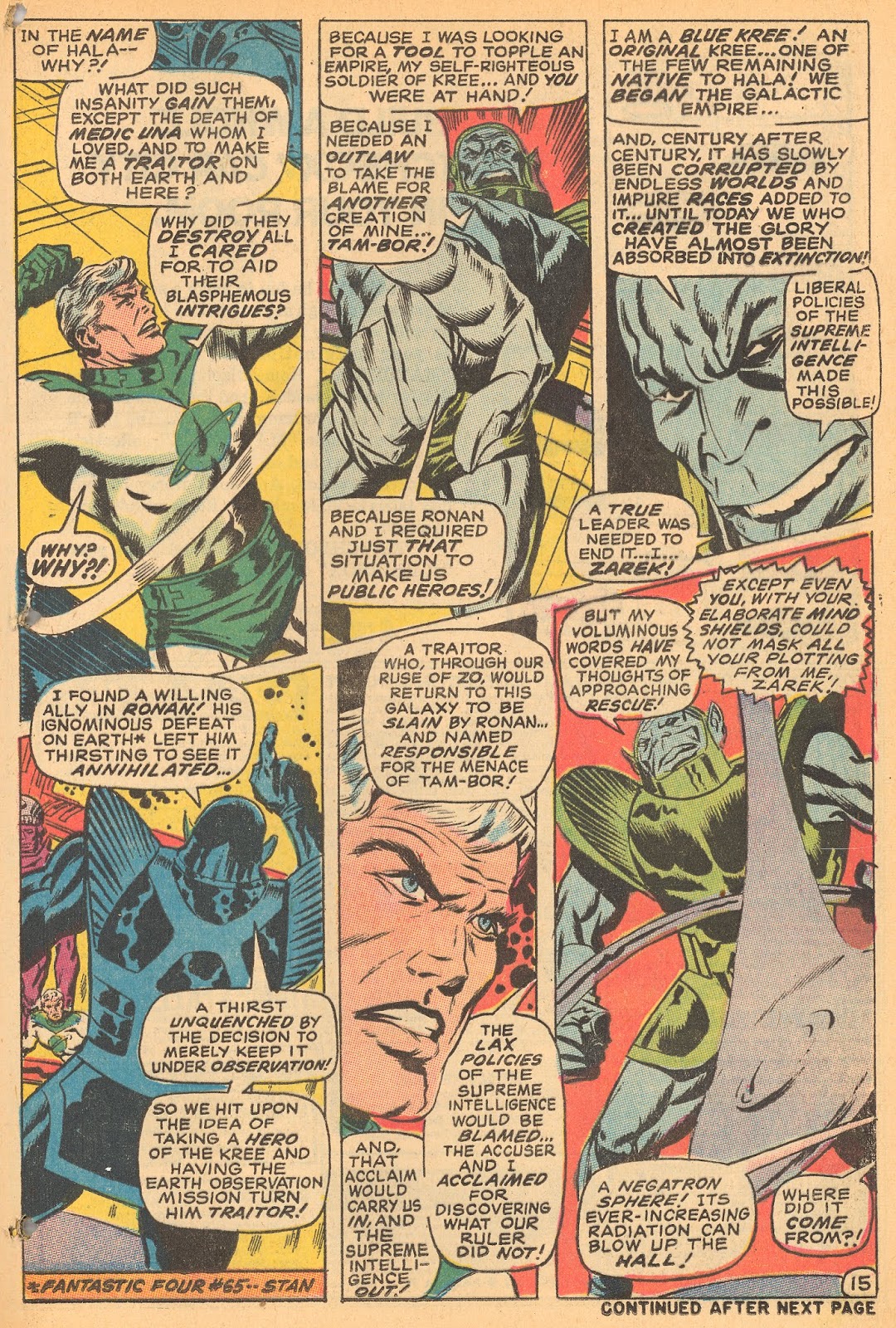
Captain Mar-Vell's girlfriend on the Kree ship orbiting Earth was Medic Una, and Colonel Yon-Rogg had eyes for Una. He was also jealous of Mar-Vell for his popularity and success. Thus he wanted to get rid of him. And when Mar-Vell was on Earth, he won the heart of Carol Danvers for rescuing her from various monstrous threats. They made out numerous times, and each time Yon-Rogg would make sure Medic Una saw it, in the hopes that she would forsake him.
Much as I can only imagine someone in the world might want to see Annette Benning as a lesbian cougar getting it on with Brie Larsen, and Jude Law as some sort of jerk who gets turned on by lesbians, or perhaps that the Kree are not so hung up on gender preference as us humans, making Mar-Vell female and eliminating Una in a Marvel superhero movie totally eliminates any romantic angle in the relationship between these three characters. On the other hand, it does serve a certain message of this movie that I will get to later.
So, on Monday Night Football last week, Marvel dropped their new trailer for their movie about Carol Danvers as a superhero, "Captain Marvel." And it is a doozy...for a few reasons.
First off, it shows some pretty impressive special effects. Not just that they are convincing, but they show that some pretty impressive things are happening. There are lightning bolts going into a girl's brain, energy blasts coming out of the hero's hands, explosions, etc. It could be pretty impressive.
But this trailer also reveals what may be the crux of the entire plot (or at least the character arc).
When we last saw Our Hero, she was crash-landing through the roof of a Blockbuster video store in the 1990's, punching out an old lady on a public transit conveyance, having flashbacks to herself in the US Air Force and as a small girl falling down and getting up a lot, getting zapped in the head by energy, shooting energy bolts from her hands on the top of a commuter train, and sharing enigmatic one-liners with Samuel L. Jackson (Nick Fury, Agent of S.H.I.E.L.D...with two whole eyes).
This debunked the fan theory that Carol Danvers was the 22-year-old schizophrenic referred to in the beginning of Dr. Strange (Why a schizophrenic? Because Carol Danvers and Ms. Marvel were a split personality in her the first year or so of the hero's presence in Marvel Comics). But it did seem to confirm that Carol Danvers is going to have been an Air Force pilot, just like she was in the comics.
SPOILER ALERT! I AM GOING TO GUESS THE PLOT OF THE MOVIE...OR AT LEAST CAROL DANVERS' CHARACTER ARC!
[UPDATE] Since I started writing this article, news has
reached me that two Funko Pop figures have revealed two character names. A character that appears to be Brie Larsen in the green-and-black
uniform and helmet of Carol Danvers is named "Vers" and a white, male, helmeted character in green-and-black (and only Jude Law fits that description so far), is "Yon-Rogg."
Carol Danvers grows up as a tomboy and speed freak, playing baseball and racing go-karts. She joins the US Air Force and becomes friends with a woman who would become the mother of Monica Rambeau. She becomes a test pilot and, somehow, she crash-lands on a planet or a deserted part of Earth and bleeds blue blood through the nose. She also has lost her memory. The Skrull warrior Talos tries to kill or kidnap her, but she is rescued by Kree. They find a fragment of her Air Force dogtag that includes part of her last name, "...vers," and use that as her name. They put her through a Kree "Six Million Kree Imperial Monetary Units Woman" procedure and make her into a leader of their super-powered enforcement squad, Starforce. Yon-Rogg is her mentor, and Ronan is some sort of supreme commander-type.
In the course of an adventure (possibly being pursued by Skrulls), her ship blows up and she crashes to Earth into a Blockbuster Video store in Los Angeles in the mid-1990's. She explores the subway, then starts to head out to the western US desert, where she blows up a storefront and meets Samuel Jacks...I mean S.H.I.E.L.D. agent Nick Fury (who has two eyes). The two of them go to a S.H.I.E.L.D base hidden in a mountain, where Danvers' thumb accesses a room in which are files about her military career (so she must have been a S.H.I.E.L.D agent somewhere in there).
The Kree come to get her and she finds out more about her past. Yon-Rogg reveals the true depth, meaning, and motivation of the Kree imperium. She decides to reject the Kree and fight for Earth.
Some things that I don't know and wonder about are as follows:
Is she a Skrull? The answer is not as obvious as I first thought. The first thought is, of course, "no." But then I got to thinking...you know, we got Skrulls here, and Skrulls are shapeshifters.. and then I thought of a recent Marvel Comics epic crossover storyline...
Secret Invasion was Marvel's big epic company-wide crossover event for 2008. In it, it was revealed that many, many people on Earth were Skrull agents. More than that, many of them were disguised as superheroes, and that they had been altered by Skrull science to be completely undetectable and not even know that they were Skrulls...until they either died, or a certain triggering mechanism was activated (usually a phrase or image).
The one who was disguised as Mar-Vell, however, was a special case. He was one of the first subjects of this process, and they went a little too far on him. The Mar-Vell memories and personality they had imprinted on him were too strong. The triggering mechanism did not work, and even when faced with a Skrull who told him exactly who and what he was, he rejected it. Instead, he embraced his Mar-Vall persona and fought against the Skrulls in space until he died in battle.
Well, the Marvel Cinematic Universe has already adapted the Captain America - Iron Man Civil War epic, company-wide crossover event, why not Secret Invasion, which followed hard upon it?
Where is Mar-Vell? Marvel Comics' first Captain Marvel (as regular readers of this blog should well know) was Captain Mar-Vell of the Kree. His superior officer was Yon-Rogg, who kept on trying to screw him over so he would have a shot at his girlfriend, Medic Una. He was sent to spy on Earth, disguised himself as rocket scientist Dr. Walter Lawson, and became close with Carol Danvers, who was then security chief at Cape Kennedy. Later, an explosion of a Kree device during battle with Yon-Rogg sent Mar-Vell's Kree DNA mingling with Danvers' which later turned her into the superhero Ms. Marvel. Mar-Vell later died of cancer, but returned years later to help save the universe (long story. In fact, much of this is a long story), but he died again, after which Danvers took on the mantle of Captain Marvel herself.
Somehow, this origin story was said to be too much like Green Lantern's. Let's see, what is similar about this? In GL, an alien cop crash lands on Earth, seeks a man without fear, who turns out to be a test pilot. He passes a magical ring to the test pilot before dying, and the test pilot replaces him as space-cop for that section of the galaxy.
So...we have an alien coming to Earth, we have some power being passed to a human with some relation to airplanes, and we have the human becoming a superhero (who, in the case of Carol Danvers, was created to be a feminist icon). That's the depth of the connection I see. Not a lot. In fact, when a human test pilot becomes an enforcement agent for an intergalactic empire and a mentor figure turns out to be a bad guy, I am seeing more Green Lantern, not less.
So, was it decided for Mar-Vell to not exist in the MCU? Then from where does Carol Danvers get the name "Captain Marvel"?
What's with the cat? Well, that's not a cat. In the comics, anyway, it's aflerken, an alien race that looks like cats. They lay eggs. They contain "pocket dimensions" within themselves. And they also can release an amazing set of teeth and tentacles to devour adversaries, should they feel a need to do so.
So why is there one named "Goose" in this trailer?
Well, in the comics, there was this orange cat that Carol Danvers, as Captain Marvel, threw at a magical supervillain named Warren Traveller. But this wasn't as the Captain Marvel we know now, but one in an alternate reality created by Scarlet Witch in the 2005 epic Marvel Comics company-wide crossover event called House of M. The relevant part of this alternate reality is that Carol Danvers, as Captain Marvel, was the greatest superhero in the world.
When she threw the cat at Traveller (a villain who did not exist in the regular Marvel Universe) he tried to escape by casting a time travel spell. He did disappear, but the cat went with him. A few days later, after the the world went back to normal, the cat showed up in Carol's apartment. Traveler materialized seconds later, and chaos ensued. Long story short, Traveler was (eventually) defeated, but Danvers kept the cat and named it "Chewie," short for "Chewbacca," the wookie from Star Wars.
A couple of years later, Carol Danvers, now Captain Marvel again, but this time in the "regular" Marvel Universe, was traveling though space , and met up with the Guardians of the Galaxy (the version on which the recent movies were based). When Rocket Racoon saw the cat, he went apeshit, calling it a "flerken" and screaming "Kill it with fire!" while pursuing it with deadly abandon.
Chewie hid in a closet, and when she was found, she was surrounded by over 100 purple eggs. The eggs soon started to hatch kittens. then it revealed the aforementioned teeth and tentacles, ridding the space ship of a particular menace. Rocket then fell in love with the flerken.
And none of that really answers what this cat named "Goose" is doing in this movie.
(Yes, "Goose" is probably a Top Gun reference, but that movie was about Navy flyers and this one is about Air Force flyers, I just wanted to end this post with the above sentence, because even that bit of info does not fully answer the question. And it is probably not a reference to the motorcycle cop in Mad Max).
Here are some videos that attempt to identify "Easter Eggs" and other clues from this trailer:
On September 4-5, there were some kernels of hints that there would be something major regarding Marvel's Captain Marvel (see how I did that? Kernel, major, captain?) released. Many people speculated that, after DC put out their SHAZAM! trailer, then for a Captain Marvel thing from Marvel we would see a big, glorious, exciting Captain Marvel trailer. And we all woke up the next day to find out that this big, glorious, exciting trailer...
...was NOT released! There was so much disappointment on the Interwebs that I could make a whole "clickbait roundup"(TM) about it. But I would rather not waste my valuable writing time on that.
Instead, let's talk about what was released:
First, EW hits us with a brief but juicy cover story
I am so certain that the clickbait network has been working overtime on this. ScreenRant alone has over a half-dozen articles about the movie pop up just since the EW reveal, and I am not going to spend my time logging them all. Instead, here are my thoughts:
1. THE COSTUME
From the moment the movie was announced and "casting rumors" started flying fan art was showing interpretations of the current Carol Danvers/Captain Marvel outfit in faked pictures of potential actresses like Katie Sackoff, Emily Blunt, and Ronda Rousey. Once Brie Larsen was announced, there were bunches of pictures of her in versions of the suit, some of which got repeated over and over in article and post after clickbait article and post whenever there was an announcement about the movie.
That suit, in the comics, is blue and red. When the first set pictures of Brie Larsen in costume came out, she was wearing a suit of black and green. The location and design of the colors were pretty close to what we see in the comics (black for blue, green for red), but speculation abounded as to why this was what we were seeing.
"It's going to be colored in post!" was one cry. "That's the green of a greenscreen!" Others with more knowledge of the comics pointed out that Captain Mar-Vell, Marvel Comics' first Captain Marvel and the one through whom Carol Danvers got her powers, originally had a white and green suit with a similar color distribution. this may have been a tribute to that, some said. At least one person pointed out that the uniform of S.W.O.R.D., an international anti-alien threat defense organization, uses black, white, and green.
The truth is out now. This is the uniform of "Starforce," a Kree strike team, of which Carol Danvers is a leading member, as is the character played by Jude Law (more on that later). But Danvers will also be seen in a blue and red version of the costume. This may have something to do with something that happens in the story (more on that later, also). In any event, the green on the shoulders, gloves, boots, and belt are in keeping with Roy Thomas' color scheme of Gene Colan's original design. We may see a "battle helmet" also, if Samuel L. Jackson's T-shirt is to be believed.
It does seem, however, that they are dispensing with the rank-specific colors and insignia as established in the comics.
2. JUDE LAW'S CHARACTER
Well, everyone from IMDB on down was convinced that Jude Law would be playing Captain Mar-Vell/Walter Lawson. I even wrote a blog post about this. It turns out that, according to this EW exclusive, what we know is that he will be a commander, and he and Carol Danvers will be working together in the Kree Starforce. The term "mentor" has been bandied about to describe his relationship with Danvers ever since the original "in talks with..." announcements were made regarding Law's casting in the movie. We see pictures of him both in what I presume is a Kree battlesuit or something (the black and green suit we have seen on Brie Larsen) and in a more casual, short-sleeved affair. We also see him with short black hair and his characteristic, pronounced, widow's peak.
In the comics, Mar-Vell did not work with Carol Danvers much after she became the superhero Ms. Marvel, and Danvers never, ever worked for the Kree. Mar-Vell started with white hair, which turned blonde later (when he gained "cosmic awareness"). His rank in the Kree military in the original Marvel Comics was "captain," not "commander. All these things are different from what we are seeing in the movie so far.
However...
We have been told that Carol Danvers' origin as Captain Marvel will be different from the comics (more on that later). Furthermore, in Marvel's "Ultimates" universe, the corresponding character to Mar-Vell - whose name is spelled Mahr Vehl - has black hair, and his rank in the Kree military is "Pluskommander," which he describes as equivalent to a captain. In addition, his human disguise/alter ego is named Phillip Lawson.
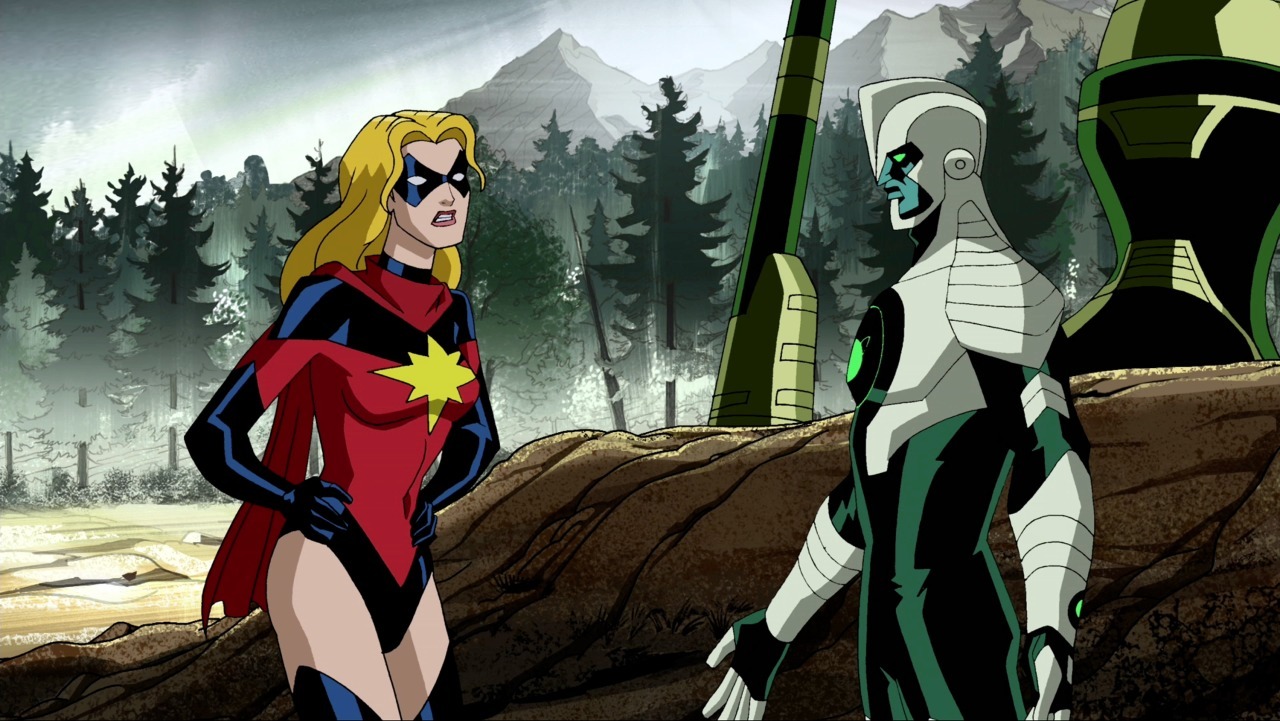
The Ultimates universe has been used as source for parts of the Marvel Cinematic Universe already, most notably, Samuel L. Jackson as Nick Fury). Bizarrely, Mahr Vehl/Philip Lawson was the Captain Marvel that appeared in the animated series Avengers: Earth's Mightiest Heroes, while Carol Danvers became Ms. Marvel with the 1970's red & blue costume and scarf, and Phyla-Vell (Mar-Vell's cloned daughter from the main Marvel universe, whose origin is tied in with the destruction and re-creation of the universe with the help of Genis-Vell, Mar-Vell's post-mortem cloned son) even makes an appearance, wearing quantum bands (I don't have time to explain all that).
So it is not impossible that Jude Law is portraying Mahr Vehl rather than Mar-Vell. Of course, we don't see any pictures of him disguised as an Earth person, so we don't know if Walter or Philip Lawson will be making an appearance.
Yon-Rogg was Captain Mar-Vell's superior. He was jealous of Mar-Vell's standing as a loyal, reliable soldier who had a great future ahead of him, and despised his kind-heartedness. He was also in love with Medic Una, Mar-Vell's girlfriend (who does not yet seem to be appearing in this movie). So he sent Mar-Vell alone on the highly dangerous mission of spying on humanity to determine if they should be wiped out. He would repeatedly put perils in front of Mar-Vell that he thought would either make the captain look bad or kill him, and hated him even more every time Mar-Vell came out smelling like a rose.
In the end Yon-Rogg's jealousy made him self-destructive. He destroyed his career and nearly killed himself in his single-mind pursuit of Mar-Vell's destruction. The climax of his pursuit was the explosion of the Kree psyche-magnitron machine which led to Carol Danvers getting superpowers (that emerged eight years later, real-time when she became Ms. Marvel. In a recent Captain Marvel (Carol Danvers) comic he resurfaced and nearly succeeded in capturing the Earth to give it to the Kree Empire, but by this time the Kree had no more interest in Earth, and besides, Yon-Rogg's authorization had long since expired. He was cut off by the Kree and defeated by Danvers/Marvel and her superhero friends.
Yon-Rogg had been drawn several different ways by several different artists. Sometimes he had brown hair, sometimes black, and Gil Kane even gave him a little villain's mustache! Sometimes he had a widow's peak. This all makes Jude Law look like he might be a fit for that role. Though -Rogg and Danvers only interacted once in the comics, since we are already breaking away from the comic continuity with Danvers being part of Starforce, why can't Yon-Rogg be the commander that eventually turns against her?
So is the hair the over/under on which character Jude Law is playing? Remember, there has been some "blackening " of characters in superhero movies and TV shows lately. Aquaman and the Flash, you may recall, each have black hair in the latest movies, but in the comics were notably, and vibrantly, blonde! Could this be the latest example of this dark trend?
There is a lot more to talk about of what Entertainment Weekly has shared with us. What do you think of what's been mentioned so far?
TO BE CONTINUED... All characters and images are copyright their respective copyright holders.
When last we left our hero-of-a-certain-name, poor sales had taken its toll, and the publishing frequency of MF Enterprises' Captain Marvel was declining rapidly.
What happened next is not altogether clear. Between Stan Lee and Roy Thomas I have heard or read at least three stories about the creation of Marvel Comics' first Captain Marvel.
The first one I read was in Marvel: Five Fabulous Decades of the World's Greatest Comics by Les Daniels, from 1991. In it, Stan said "I thought it would be terrible if someone else had the name when we were Marvel Comics. After extended legal and business negotiations, we got ourselves the rights to the name, but DC ended up with the old character. I thought we'd better do a book, so I wrote one about an alien from another planet."
Well, Stan is a great storyteller, but is not always the final authority on what actually happened. In this case, DC wound up with the "old character" through a business deal that had nothing to do with the legal action between Marvel and MF Enterprises. We will cover the legal action and the business deal soon.
In Alter Ego magazine and in the introduction to the first Marvel Masterworks edition of reprints of Marvel Comics' first Captain Marvel, Roy Thomas states that it was Martin Goodman, publisher of Marvel Comics, who noticed the MF Enterprises Captain Marvel and decided Marvel ought to protect its trademark and create its own, and handed the assignment to Stan.
Recently Roy Thomas has said to me that he remembered Stan talking at a college and saying that there was a TV deal offered to Marvel for a superhero from outer space named Captain Marvel if Marvel would create the hero. The author Tom Wells, inAmerican Comic Book Chronicles: 1965-69 from TwoMorrows Publishing, repeats this, adding that it was an animation studio's project. I will fill out the details of that story elsewhere.
Whichever is true, or whichever parts of each of those stories are true, on the cover of Marvel Super-Heroes #12 (December, 1967) was a mysterious new "super-hero": a white-and-green clad figure by the name of... Captain Marvel.
A few months previously, the Kree, a race with a sprawling, militaristic, intergalactic empire, had first been referenced in the pages of Fantastic Four #65 (August 1967). They had been to earth long ago and planted secret bases and giant robots called "sentries" all over. The F.F. had discovered and defeated a sentry, so this Captain Marvel's first story was about an expedition was sent to determine if the people of Earth were a threat and should be destroyed.
The eponymic hero of this story was Mar-Vell, a captain in the Kree military (get it?). He was the expedition member selected by Colonel Yon-Rogg, to go to the planet to investigate. Yon-Rogg was was jealous of Mar-Vell and had designs on his lady love, Medic Una, and thus went out of his way to put Mar-Vell in positions of danger, while Una spent a lot of time weeping over this and calling out Yon-Rogg for his duplicity.
At this point it is hard to describe the character of Mar-Vell without lapsing into synopsis because he changed...a lot.
First he was sent to Earth on his solo mission and checked into a small rural hotel as "C. Marvel." Then Yon-Rogg tried to zap him with a laser from orbit but hit a small plane instead, killing a rocket scientist named Dr. Walter Lawson. Mar-Vell took the dead man's identity (they looked alike) and reported to work at a US missile base known as "The Cape" (later revealed to be Cape Kennedy/Canaveral, although initially the landscape was drawn as a rocky, mountainous, desert region).
Then he met Carol Danvers (the future Ms. Marvel/Binary/Warbird/Captain Marvel. We'll get to all that later), head of security at The Cape, who had been suspicious of Dr. Lawson before Mar-Vell showed up. Then robots and monsters attacked the Cape on a regular basis, Mar-Vell kept fighting them off, rescuing Carol Danvers often in the process. Danvers remained suspicious of Lawson, fell for Mar-Vell, while Yon-Rogg plotted against him and made sure Medic Una was aware of every time Danvers made goo-goo eyes at him...and when they kissed.
To cut to the chase, Mar-Vell was used as a pawn in Kree ethnic politics (the blue-skins were pure, the "pinks," like Mar-Vell, were mixed with other races) and got new powers as a result (including space flight and the ability to cast illusions); Una died from a stray laser blast in a battle between the Kree and their enemy, the alien race known as the Aakon; the late Walter Lawson turned out to be a real enigma that was never solved; Mar-Vell wound up acting like a villain on Earth and had to leave, taking the body of Una and burying her on an asteroid; and when all was said and done, the Supreme Intelligence of the Kree (I'll explain that elsewhere) decided to punish Mar-Vell for disloyal deeds he had done by declaring that he would never rise above the rank of captain, but honored his bravery by letting him keep his new powers and granting him a new uniform.
Unfortunately, within moments of getting that new uniform, his powers somehow sucked him into the Negative Zone...and the readers had to buy the next issue to find out what ground-breaking, galaxy-shattering change Roy Thomas and Gil Kane would bring to Mar-Vel that would re-define his character forever! (Hint: It wasn't Snapper Carr)
Very early on, however, Myron Fass, head of MF Enterprises, decided to sue Marvel Comics. The Wall Street Journal is my primary source for this info, and here it is...
To sum up: Fass sued Marvel for trademark infringement, being as he had published a "Captain Marvel" comic first. Martin Goodman had offered Fass $6,000 for his hero character earlier, but Fass had refused. Marvel's defense was simply that their trademark on "Marvel" included all usages of it, including as a superhero name. The article was written at the start of the lawsuit, so it doesn't state the outcome, but at least two sources have stated that it was settled with Marvel paying Fass a few thousand dollars (far fewer thousands than Fawcett had paid DC to settle their suit).
So here is the news: JUDE LAW IS GONG TO PLAY CAPTAIN MARVEL (MAR-VELL...probably)!
The clickbait press was all over this one as soon as the sister publications Deadline and Variety announced that Jude Law was "in talks" and "negotiations" for the role. Headlines over the next couple of days were about 50-50 between "is" and "might be." That "in talks" status seems to be what is current, though the Net-o-shpere is pretty much taking it as a done deal
.
Variety describes the role played by Law as "Doctor Walter
Lawson, a.k.a. Mar-Vell, who becomes a mentor of sorts to Danvers as
she tries to figure out her new powers."
I think this is an interesting choice. Physically, Jude Law is not as tall as Mar-Vell, nor does he have white or blonde hair and blue eyes, as Mar-Vell has had. He is lean and fit, though.
Mar-Vell has gone through several looks during his time. Initially, as drawn by Gene Colan, Don Heck, Dick Ayers, and others, he was a beefy, square-jawed hero, with short white hair and a frustratingly generic average handsome white man face. Gil Kane made him leaner and his face longer and more expressive. Jim Starlin continued that trend, also cueing off of Kane's had given him, and finally Pat Broderick gave him his version of a hero face, with a pompadour and sideburns growing through his mask.
The difference between the Colan and Broderick Mar-Vells were so great,
it was almost laughable when, in a Broderick-drawn story, a character
saw him without his mask and identified him as Walter Lawson (an alter
ego he had not used for ten years, real-time)
This just goes to show that Jude Law's specific features and physique
are not so important when casting the role, so we can just move on from
that. Instead, let's consider the character and Law's previous body of
work.
Marvel Comics' first Captain Marvel was never a top-tier character in terms of popularity. His comic was always teetering on the precipice of cancellation, switched from monthly to bi-monthly, and even was cancelled a few times. The character went through some wild, shark-jumping escapades, being put through major changes at a dizzying rate, often in an attempt to boost sales. Through all these changes, the character, understandably, was confused. He was often "seeking his place in the universe." Having deserted the Kree, then driven from Earth, he was a man without a home for a while. During his lengthy period of sharing time in the Negative Zone with Rick Jones, neither he nor Jones were able to put down any kind of roots anywhere.When the two finally separated their time-sharing for good, he bounced around from place to place, never staying in one place for more than two issues, until he finally found the love of Elysius and settled down on Titan for a few brief years, until he died of cancer.
This rootless uncertainty made him a bit of a tortured soul. Even his "cosmic awareness," granted to him during Jim Starlin's run with the character, could not calm his uncertainty. It did, however, enable hi to handle challenges of a super-villain nature with a sense of yogi-like serenity.
Jude Law has shown himself to be very good at serious, sensitive roles in movies like Gattaca, Cold Mountain, and Enemy at the Gates. If that aspect of his character is explored in the movie, Jude should do well in the role. He has also played a hero mentoring an adventurous female in Sky Captain and the World of Tomorrow. I could see some of that coming into play in his relationship with Carol Danvers.
Mar-Vell was an accomplished warrior for the Kree when he was first introduced in the comics, and his stocky build was perfect for that role. He was constantly battling giant monsters or hordes of enemy soldiers. Jude Law's smaller frame is not, at first glance, built for such a role. In Enemy at the Gates he was a sniper, so being smaller he was able to sneak and hide, and he did not have to engage in fisticuffs. He just had to serenely find his target and shoot.
This would serve the "cosmic awareness" aspect of the character better than the "alien warrior" aspect. When the cosmic entity Eon gave Mar-Vell the power of Cosmic Awareness and made him the "Protector of the Universe" With this new power, instead of having to engage in a slugfest with a powerful foe, he could sense his adversary's weak points and center of balance and defeat him with a minimum of effort in a minimum of time with a minimum of damage. With that ability, the hero does not have to have big, showy muscles.
In the "Someone is Wrong on the Internet" department, Cheat Sheet has posted a whole "What We Know About..." article by Brendan Morrow. However, despite most of the article being pretty darn accurate regarding the character of Mar-Vell, the author commits one unforgivable sin. He states "the first time we were ever introduced to someone called Captain Marvel,
the character was a man who was referred to as Mar-Vell. He also used
the pseudonym Walter Lawson."
As anyone who has watched my video of the history of the many Captain Marvels knows, the original Captain Marvel was Billy Batson's alter ego, into whom he transforms when he says "Shazam!" The fact of this error is compounded by the GIF that is posted in the article of Garret Craig as the Fawcett-DC hero in the 1979 TV special "Legends of the Superheroes: Superhero Roast."


 The child and dead versions of Mar-vell in Earth X






 Posts
Posts


