Amazon ad

Showing posts with label captain marvel jr. Show all posts

Monday, June 17, 2019

POWER of SHAZAM! and the history of ALL the Captain Marvels (Part 14)

Note: This page is continually being updated. Please feel free to revisit to see updates as more information and images get added to this entry.

In the early 1990's DC wagged its tail to the speculator market no less than Marvel. Although they did not have an exodus of artists like Marvel, they still needed to do something to remain relevant. Thus came The Death of Superman.

As we saw in the last chapter, the 1993 Death of Superman saga at DC was the high-water mark of the speculator's market and the comics industry serving it. As we also saw in Part 11 of this history, DC had combined all of its multiple "universes" into one through the Crisis on Infinite Earths in the 1980's. As the 1990's approached the midway point, both of these events were showing their downsides. The speculator's market bubble burst, leading to a precipitous decline in sales across the board, and inherent contradictions and unsettled character histories revealed weaknesses in the continuity of the new DC universe.

In an apparently unrelated move, the SHAZAM! franchise was revived.

DC's version of the original Captain Marvel, now (as of Part 12 of this history), the version created by Roy Thomas in SHAZAM! The New Beginning, had not been seen much since that 1986 mini-series. John Byrne proposed a version, wrote a story, and even drew a couple of pages, but that project never saw fruition. The Big Red Cheese did make big appearances; in 1991, as part of the War of the Gods miniseries, and in 1992, battling a Superman possessed by the villain Eclipso.


But while all this was happening, in 1991 Jerry Ordway was asked (according to his introduction in the most recent reprint volume of DC's initial revival of Captain Marvel and the Marvel Family) to "relaunch the SHAZAM! characters." He researched the DC revival, the Fawcett comics, and even the Republic Pictures' Adventures of Captain Marvel serial. In 1994, his new graphic novel, The Power of SHAZAM! was released.
  

This gloriously drawn and painted, this new production was a loving tribute to the character and its history, but made certain drastic departures from the original stories.


In this story, Billy's parents, C.C. and Marilyn Beck, were archaeologists murdered during a dig in Egypt by Theo Adam, in the employ of Thaddeus Sivana, the wealthy industrialist who financed the mission. Billy wound up selling papers and living on the street when he was taken to the wizard Shazam by a stranger through a subway tunnel. Once he got his powers, though, he hated them. They were confusing and he lacked the maturity and experience to use them properly.

(And yes, this was where the recent movie got the names of Billy's parents.)

The "McGuffin" of the story, a scarab necklace on an ancient mummy, gave Theo Adam the power to transform into Black Adam, and it turned out that he was really the ancient villain reincarnated. He quit Sivana's employ, Sivana's financial empire and plans and schemes crumbled, Billy adapted to being Captain Marvel and defeated Black Adam, and the stranger who had led Billy to the old wizard turned out to be the spirit of his dead father.

But this was a different Captain Marvel. Set in a more realistic world where a 10-year-old boy living on his own would be snatched up by civil authorities, Billy Batson had to figure out how to survive, and turned out to be a scrappy, self-reliant survivor.

Jerry Ordway established Fawcett City as the home of Billy Batson/Captain Marvel (after Roy Thomas had created it for a story in All Star Squadron about ten years earlier) and made the city one that retained the modernist Art Deco style of the 1930's. This and other elements were blatant tributes to the Fawcett stories and the work of the writers, artists, and editors of those days. Streets were named after Fawcett-era writer Otto Binder and artist C.C. Beck, Billy's father was named after Beck, a scene of Captain Marvel throwing a car against a wall was an obvious tribute to the cover of Whiz Comics #2, and the subway tunnel, train car, and throne room of the old wizard were adapted very faithfully (with some detailization) from the original story.

The book was a big hit, critically and commercially, and led to a new series of the same title.

But before that new series began, in September 1994, DC began a new, company-wide, crossover epic miniseries, Zero Hour. It seems that the Crisis on Infinite Earths series of 1986 had set up a bunch of contradictions and failed to resolve certain matters in the DC Universe, so Zero Hour was an attempt to fix it.


As a result, a new DC Universe was established, mostly similar to the previous one, but it was assumed by most who cared that this re-invention of Captain Marvel was to belong to this post-Zero Hour world.

And thus did the new Power of SHAZAM! ongoing series begin in 1995. Set a few years after the graphic novel, Billy had his job at WHIZ broadcasting and was attending school. The school janitor, Mr. Dudley, helped the boy out where he could. Billy's uncle, Ebenezer Batson, had thrown him out on the street. In his Captain Marvel form, Billy would sometimes disguise himself to act as his own uncle or get work on the side.

The wizard Shazam played a much more integral part in the stories than he had in the Fawcett and pre-Crisis DC stories. It was revealed that his throne room was in the Rock of Eternity which was reached through a dimensional barrier. The old wizard had cast a spell on Fawcett City to make time pass more slowly and protect it from certain dangers, thus ensuring it kept it's Art Deco look and 1930's-'40's styles and cars all the way to the end of the 20th century.

Theo Adam/Black Adam was a regular adversary of the Marvel Family through the series. Eventually the Theo Adam personality was completely subsumed by Black Adam, to the point where his alter ego was his ancient self - Teth Adam.


The series started with both Billy and the wizard looking for Billy's sister Mary, and found that she had been adopted by the wealthy Bromfields, Nick and Nora (obviously based on the comedy-detective duo from the 1930's "Thin Man" series of films).

Mr. Tawny, the talking tiger from the Fawcett/DC comics, turned up as a "pookah," a Celtic shape-changing spirit who appeared to most everyone as a stuffed tiger doll, but to Billy and Mary was a full-size, anthropomorphic tiger. He guided Mary to say the magic word, granting her powers, but instead of calling herself "Mary Marvel," she called herself "Captain Marvel," so now there were two Captain Marvels.
 

Freddy Freeman was a recurring character as well, a star high school athlete and Big Man On Campus, but near-death injury resulting from Billy/CM's battle with Captain Nazi led to him being orphaned and granted the power to become Captain Marvel, Jr. by saying that "Captain Marvel." Because of the difficulty in introducing himself without transforming, he eventually chose to call himself "CM3."
  

CM3 at first had a crush on Mary, but it didn't go over well with Billy, so the third Marvel left town, joined the Teen Titans, and later the more edgy Outsiders.


The wizard Shazam involved himself directly in the lives of the Marvel Family, breaking up arguments and guiding them to important tasks. At one point he left the Rock of Eternity to explore life on Earth again, often comparing life today with that of the 1930's and '40's, a period of which he was fond, hence the magic spell he had cast over Fawcett City.

One unique detail regarding the powers of the Marvel Family in this version was that they were limited. When two or more of them were in their "Marvel" identity, that limited power was shared. So each of them became less powerful, less invulnerable. Black Adam was even able to break Billy/CM's arm under such circumstances. This limitation, however, was eventually eliminated when Ibis upgraded their powers while covering the old Wizard's position at the Rock of Eternity.

The wizard Shazam was brought into DC's magical realms, including the afterlife, and a couple of supernatural Superman villains, Blaze and Satanus, were revealed to be his children. The old wizard even advanced to godhood before the series was over (in the polytheist, mythological, Jack Kirby's New Gods style).

Mr. Tawny, it turned out, had been a stuffed animal all along, but given the opportunity to be "real" by Blaze, if he did her bidding. When Blaze was defeated, Ibis gave him the option of remaining a real, anthropomorphic, talking tiger. He jumped at the chance, and became a recurring character in the DC universe.

The series, like the graphic novel, had a lot of references to the Fawcett years. Street names, businesses, and characters were named after writers, artists and editors from Fawcett. Obscure characters like "Muscles" McGinnis made appearances, as well as old Fawcett heroes like Ibis the Invincible and his companion Taia, Bulletman and Bulletgirl, Mr. Scarlet (actually his old sidekick Pinky bearing his former mentor's identity), Spy Smasher, Minute Man, and Lance O'Casey.

Villains from the Fawcett stories that appeared included Ibac, Mr. Mind, Mr. Atom, and the Arson Fiend.

The series lasted for 47 issues (with one extra "One Million" issue as part of a company-wide crossover event that some count as the 48th). In it Ordway was able to explore the awkwardnesses of Billy trying to get along in adult society as a superhero although he was a teenage boy. He eventually got adopted by the Bromfields and they were able to live together as a family.

Additional Shazam-powered characters, some named "Captain Marvel," some not, were created in this series: C.C. and Marilyn Batson were Captain Marvels in an alternate timeline created by Sivana (now refered to as "Dr. Sivana.")
       
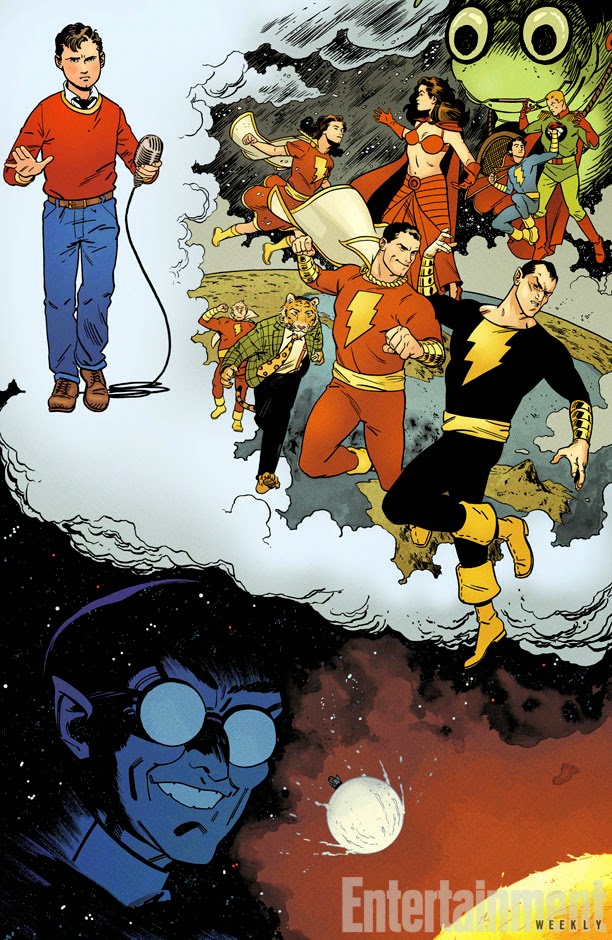
This three-part story also featured a great full-page illustration that interpreted several Captain Marvels in SHAZAM! style! (Note also the letters embedded under the golden man's arms!)

In Power of SHAZAM! One Million, the hero was a young man on the planet Mercury named Tanist, granted the power by an aged Billy Batson/Captain Marvel in the far future.
  

In the 1996 Power of SHAZAM! Annual, the hero was Cecebeck, who took the name "Thunder" when superpowered. She would later join the Legion of Super-Heroes.
  

DC had created a line of books under the imprint "Elseworlds," in which the heroes were put into alternate histories, contexts and situations. In Elseworld's Finest: Supergirl & Batgirl #1 (September, 1998) there was a Captain Marvel in the Justice Society. This was the first black Captain Marvel to see print in DC.
 

During this time, Captain Marvel made significant appearances in miniseries like Kingdom Come and Underworld Unleashed. When used to best effect, Billy Batson's humanity, youth, and purity of heart were deciding factors in the outcomes of the stories.


During this time the Big Red Cheese shared stories with many DC heroes, both as guests in their books and with them as guests in his, including Superman, Batman, the Flash, Green Lantern, Plastic Man, Starman, and even this old favorite...

The series was highly regarded critically and sold well, but not well enough to avoid being cancelled just shy of its 50th issue (which disappointed Ordway). The final issue had a cover that was directly inspired by the cover of the final issue of DC's first SHAZAM! series:
    

 But though this series did not last out the decade, this Captain Marvel remained a major player in the DC universe...

Next for the DC Marvels: Society, Leagues, and crises, crises, crises!
For the Marvel Marvels: Genis-Vell cracks up! and Marvels, Marvels everywhere!


Tuesday, September 5, 2017

Shazam! Movie Update: The Hero Will Be...

John Cena and Joshua Sasse are front-runners for the role of Captain Marvel in the "Shazam!" movie! Billy Batson's character description is out! A script has been written and the plot synopsis is out!

Yes, folks, that is what the clickbait media are saying, and I have just done my service to my click-count by putting all the keywords in the first paragraph.

So let's start with the big news first: The hero's name. Back in 2007, DC pretty much gave up the fight of having a superhero with a name that could not be put on the cover of the book. The trouble (as regular readers of this blog and viewers of the associated YouTube channel and members and followers of the associated Yahoo and Facebook groups and Facebook page know) is that when DC licensed the original Captain Marvel from Fawcett Publications, Marvel Comics had trademarked the name "Captain Marvel," so DC decided to title the comic book for this character "SHAZAM!" (all caps, with the exclamation point). Shazam has since been used as the trademark for all merchandise, properties, and productions surrounding and involving this character. It is therefore understandable that people who would never read the book, watch the TV show, or play the video game would never know that the hero's name was really Captain Marvel.

So as part of a company-wide crossover event, Captain Marvel underwent a transformation in which he became a sort of "guardian of magic" character on the Rock of Eternity with the title "Lord Marvel," and his role on Earth was taken over by the former Captain Marvel, Jr, Freddy Freeman. He had recently lost his powers, however, and to gain them back he had to undergo a series of trials chronicled in the 12-part series "The Tirials of Shazam." At the end of that series , Freddy emerged in the classic red suit with the superhero name that matched the acronym of the source of his powers, Solomon, Hercules, Apollo (who replaced Atlas after he was killed), Zeus, Achilles, and Mercury; SHAZAM!

Dan Didio himself confided to me how relieved he was that at last they have a hero whose name is the same as the title.

That turned out to be temporary, however. The old wizard named Shazam, whom everyone thought was dead, returned and took his name back, and Freddy was now the new Captain Marvel.

But before anything else could happen it was 2012, and CD came out with the New 52, reinventing all their characters, some more than others. In the case of Captain Marvel, his powers changed, his origin changed, his costume changed, and his name was now "Shazam."

Of course conspiracy theorists, semi-fans, and other folks who have not had the good fortune of growing up with this character and having researched the legal history and ins-and-outs of the trademark and copyright and other issues going on, started assuming things like it was now illegal to call Captain Marvel Captain Marvel, or that Marvel Comics had sued, or any number of other reasons why the change happened. So the next thing you know, there were YouTube videos proclaiming to tell the "History of Shazam" and talking about the character as if he used to have the name "Captain Marvel."

Just to make things more confusing, the universe of the "New 52" turned out to be part of a multiverse of 52 universes, one of which (Earth-5) was the home of the original Captain Marvel.

Then, in 2014, Dwayne (the Rock) Johnson broke the news that the Shazam! movie project was up and running again (you can read back through my previous posts to follow the history of its first incarnation from 2003 - 2009). There was a resurgence of interest in the character, with a concurrent surge in YouTube videos and clickbait articles about him, along with the usual casting rumors and speculation. With each of those videos and articles was, either in the content or in the comments (usually both) something not 100% accurate about the history of the character and his ownership and where the rights lay regarding the character's name and its use.

One thing was never made clear, though, either by accident, design, or legal obligation: What would the name of the hero if this new movie be? Most reports of the movie would use the New 52 character's name, as it was the same as the the title of the movie and besides, either the writers never knew the name as anything different, or they assumed that the name had been changed for good. Illustrations representing the character would be of both the New 52's "Shazam" and the classically-based Captain Marvel. Moreover, since there had been several reboots of the character since 1986, much of the material available was of these reboots, and not the original character. This made for some interesting mish-mashes from those who did not know their history.

So as people would be saying "He will always be Captain Marvel to me!" and "Get over it, it's illegal for DC to use that name!" and so on, I would chime in, pointing out that the studio had not yet said whether the hero would be the New 52 version,named "Shazam," or based on the original, and named "Captain Marvel."

Well, if the words released by thathashtagshow are to be believed as genuine, it looks like they have decided. Below are the "plot synopsis" for the movie and casting notice for Billy Batson:

"Based on the DC Comics character “Shazam!” Billy Batson becomes Captain Marvel, the world’s mightiest mortal, when he says the magic word “Shazam! The name is an acronym for six gods and heroes of the ancient world as well as their attributes. The wisdom of Solomon, strength of Hercules, stamina of Atlas, power of Zeus, courage of Achilles and speed of Mercury."

"Male, 12-15 years old. A teenager who becomes Captain Marvel, the world’s mightiest mortal. Granted access to incredible powers by the wizard Shazam, he speaks the wizard’s name and is struck by a lightning bolt that gives him the powers of the gods."

If that  isn't enough evidence, the director, David F. Sandberg, has been posting a picture each day in his Instagram page, and here is the latest...


Not a "New 52" to be seen! Nor a "New Beginning," a "Power of..." a "Magic of..." or even a "With One Magic Word..."! Just classic, Fawcett Captain Marvel comics, a couple of action figures of the classic Cap, a tiger, a worm, and a bunch of cans of Coke Zero. And a picture of the King of Sweden. In a Viking helmet.


There is a nifty in-depth analysis of the picture by Mark Siefert at BleedingCool.

Whatever else this says, it does not say "New 52." It says CAPTAIN MARVEL!

Next: About those casting rumors, plot details, and possible connections to "Flashpoint"...

Wednesday, June 3, 2015

Shazam: Convergence review part 3

(continued from previous post)...Of course, a "by the numbers" adventure with the Marvel Family is still fun (especially when you add Mr. Taawny in an open-cockpit WWII fighter plane). And the subtle combination of the lighthearted elements of the Shazam heroes and villains with some logical character explorations and the deeper, darker dimensions of the Multiverse was handled with great skill, allowing the reader to enjoy the ride while appreciating the depth.


But as I said, a great opportunity was missed here. Gotham by Gaslight, on its face, appears to be a drastically different world than that of what DC called "Fawcett City" on Earth-S or Earth-5. It is a dark, scary, treacherous, mysterious, well...Gothic...place. However Billy, Mary, and Freddy are not actually strangers to such a world. On several occasions, both individually and as a family the Marvels found themselves in such environs, Freddy in particular lived in a quasi-gothic evnironment, especially when drawn by Mac Raboy. He dressed in rags, lived in a run-down boarding house, and often found himself defending orphans, waifs, and even magical fairy creatures that would not be unfamiliar to a Victorian audience.

It would have been interesting to see the Marvel Family deal with the challenges of a dark Victorian, steampunk adventure in a full-length story. In their human selves, I could see Billy, the young adventurer, intrepidly seeking clues, while Mary, the adopted daughter of privilege, and Freddy, the poor orphan boy, being concerned with the welfare of the downtrodden. As their heroic personas, Captain Marvel would be initially perplexed by the mysterious ways of the creatures of darkness, Mary Marvel would be drawn to the plight of the underclass, while Captain Marvel Junior would use his familiarity with the environment to start to see the solution. Together, their wisdom and courage would see them through. It's quite possible their strength, speed, and abilities would help the Batman of this world solve a mystery that had eluded him, and perhaps, in a more ambitious tale, would even help him solve a particular social evil.

But this was just a one-time, two issue story that was part of a bigger, company-wide, crossover epic. We will probably never see this combination of characters and worlds ever again (outside of fan fiction, of course). In time, it will be reprinted in a trade paperback collection, perhaps a giant omnibus edition, but it is unlikely that it will be one of the Great Epic Tales that will be remembered in the annals of comic book history.


So we will see what DC will do with the former Fawcett characters in whatever world will emerge from "Convergence.." I hope they will return these characters to their roots with their original names, powers, and characteristics. They cave the DC universe a lighter touch and needed balance when things got all grim 'n' gritty in the 1990's. I prefer that Billy and Cap have separate consciousnesses, but if they must have the same mind, at least have Billy be the kind of kid to whom you would want to give superpowers. If you want to have a troubled kid find redemption, make up a new character. You could even have him be in the "Shazam" family, but let the first, the original, the leading Hero of the Word be a brave, pure, good soul to set an example for the rest.

Friday, May 29, 2015

"Shazam" Convergence review part 2

Because nobody who reads comics can possibly expect anything in one comic book by one company to not affect anything in any other comic book by that company (and maybe other companies as well), when change happens, it happens big. Also, when you make a big change that affects every character in every book that you sell, everyone is going to have a reason to buy the book that month, and possibly other books as well.

This has been a guiding principle of the major companies that produce superhero comics since the 1980's; every few years try to raise the stakes and come up with the GREATEST, MOST AMAZING, REVOLUTIONARY, MIND-BLOWING CHANGE EVER! This week it was "Convergence."

So we got these 52 universes, right? So instead of letting them exist and visiting them occasionally, let's BLOW THEM ALL UP IN A MASSIVE CROSS-OVER BATTLE EPIC!

So DC has revived the heroes and villains of various past titles, storylines, and alternate universes in its history and mashed them together in titles that place them in conflict with each other. In the case of the classic Marvel Family (aka: "The Shazam Family") they get placed in conflict with the world of "Gotham by Gaslight," a late-Victorian version of Batman that has come to include such genres and tropes as Gothic horror, German expressionism, pulp adventure, and steampunk.


The two-part mini-series "Convergence: Shazam," written by Jeff Parker and drawn by Evan "Doc" Shaner, starts on Earth-S, or at least that's what it says inside the front cover of the comic. The world is much like that in the DC "Shazam!" stories between 1972 and 1985, with all the same characters (Billy, Mary, Freddy, Uncle, Mr. Morris, Tawny, etc) and there is plenty of "fan service" in things like brand names and background characters. The villains are classics, (Dr. Sivana, Mr. Atom, King Kull, Ibac), and reference is even made to the suspendium trap and the Marvels' 20-year absence.

There are differences, though. It is implied that Mr. Morris was not in the suspendium trap, while in fact, on Earth-S, he had been.  There was no Fawcett City on Earth-S (unless you count that one issue of "All Star Squadron" in which Roy Thomas first named Billy Batson's hometown), the original home of the Big Red Cheese was always unnamed, but assumed to be New York. But these are nit-picks that only some sadly over-passionate fan would care about or even notice...

The art is remarkable. It appears to be an almost photo-realistic interpretation of the original characters, but with enough detail left out to give the feeling of C.C. Beck's deceptively simple-looking art from the Fawcett days. As such it seems like a logical progression of where the art would be had the series continued under the same management over the decades (a look at recent versions of "Archie" shows a similar evolution, especially in certain "alt-Archies" like the zombie-horror series "Afterlife with Archie."). All the characters maintain their distinguishing characteristics and are instantly recognizable, but the drawings look like they were taken from life, as if they found the perfect actors for each character. This shows both the skill of the current artist and the brilliance of the original, to be able to interpret the cartoony drawings into recognizably realistic people and to create cartoony drawings that could be interpreted so.

The first issue stayed on this world, and the second one moved into the world of gaslight Gotham. But before it did, the first page of issue #2 declared that this world, that of Fawcett City, was Earth-5.

CONTINUITY VIOLATION ALERT!

EARTH-5 IS NOT EARTH-S!

As I mentioned in the first part of this review, It was publicly stated that Earth-5 is not Earth-S. This can be confirmed by looking up Wikipedia and DC Wiki (note the separate listings for Earth-S and Earth-5). A couple of notable but important differences are that in Earth-S Mary Marvel has a red costume, while in Earth-5 her dress is white, and that the "Seven Deadlies" in Shazam's throne room are "Enemies of Man," while on Earth-5 they are "Sins."

Speaking of Mary's costume, in the "Convergence" stories she is wearing a mid-length-skirted, short-sleeved dress in line with her costume in Jerry Ordway's "Power of Shazam" series that is a compromise between the short-skirted dress in which she originally appeared and the full-skirted, puffy-sleeved dress she wore for most of her Fawcett years. In any case, she is not wearing the short-skirted dress in which the Shazam-bolt descended from her neckline and the cape was mysteriously attached with no cord as she did in her later Fawcett years and all through her pre-"Crisis on Infinite Earths" tenure at DC, which is Earth-S, for all intents and purposes. She is also wearing boots, not slippers, as she would have in that period.

When the story moves to Gotham (or, as the promotional blurb would have it, "Shazam meets steampunk"), Shaner's graphic style and the colors by Jordie Belaire effectively convey the Gothic Victorian gloom of the gaslight city. There is fan-service galore, if you know what to look for, all through the story, from Mary Marvel catching a bomb to Killer Crock hurting himself trying to attack Captain Marvel (geek points if you can name the inspirations of those references). The story spends precious little time in that world, however, and almost no time with Batman. It's as if the ostensible co-star of the whole two-issue story was really more of a guest-star, a supporting character, barely more than a cameo.

But the unexpected money-shot for me was one two page spread in which Captain Marvel and Billy Batson spoke to each other in the instant between the transformation.

The hero had been zapped by electrically-produced lightning from gaslight Gotham. Apparently the charge, though not magical, was strong enough to effect the change. In a conversation that must have been going on inside their minds, the two characters, the hero and the boy, recognize the situation and try to figure out what to do about it. This established what I had always believed, and what was clearly intended, for the characters from the beginning: Billy Batson and Captain Marvel are separate characters. They share memories, but they are each distinct personalities. The Shazam/Captain Marvel concept is not "Big" as a superhero, it is a boy who has the ability to transform into an adult superhero by saying a magic word.

This was the high point of the story as a piece of superheroic fantasy for me. But sadly, beyond that, it was pretty much by the numbers. This is unfortunate, as there was so much more that could have been explored with this combination of elements... (to be continued)

Thursday, May 28, 2015

"Shazam" Convergence Review, part 1

After having been out of the comic book market for a month and a half due to my trip to the medieval combat world championships (my documentary of the USA Knights is coming soon) so I finally got a chance to catch up on the whole "Convergence" thing happening with DC Comics and the role of the original Captain Marvel in it.

It started, if you will, with the "Multiversity" event, a storyline in which the different universes of the "New 52" were explored, some being developments of "Elseworlds" concepts from years ago, some being brand new interpretations of DC characters and superhero tropes, and one being a new interpretation of the classic hero and his word from Fawcett Comics.

As regular readers of this blog know, the original Captain Marvel was acquired by DC Comics in 1972 and his stories began pretty much where they left off, with an explanation of how the Big Red Cheese, Junior, Mary, the Sivanas, and most of the other back-up characters had been trapped in a vessel of "suspendium" for 20 years. DC also explained that these characters existed on "Earth S," a parallel Earth in which the regular DC characters did not exist. After the "Crisis on Infinite Earths" of 1986, all the alternate universes were combined into one, and some major characters, including the Big Red Cheese, were "rebooted" and given slightly different interpretations.

Then the New 52 hit in 2012, and DC rebooted their entire universe and every character in it. They established that there are 52 alternate universes and implied that there was an "Earth 5" that appeared to be a copy of Earth S (5 = S, get it?).  It was stated publicly, however, that Earth 5 was not Earth S and that we would find out, someday, what it was.

What it was was revealed in the Multiversity one-shot "Thunderworld." This was a fun, entertaining romp written by Grant Morrison and drawn by Cameron Stewart that introduced the world of Earth 5, in which the Marvel Family, with the help of Tawny, Uncle, and the Lieutenant Marvels defended Fawcett City from the Sivana Family and the Monster Society, as Dr. Sivana captured the Rock of Eternity and stole enough suspendium with the help of alternate-universe Sivanas to create an 8th day of the week. It was a brilliant combination of the hokey ficto-science and adventure of the classic Fawcett stories with multi-cosmic and, frankly, disturbing elements of Multiverse.


In "Thunderworld," the re-interpretations of certain classic elements (The Lieutenant Marvels now included Uncle and Tawny and were a uniformed, rocket-packed, sci-fi-weapon-bearing squadron, and Billy used a cell phone with his updated backpack broadcasting equipment) were handled lightly and not out of character with what one might expect from an organic progression of the characters from the 1940's. Dr. Sivana's motivations were consistent with the character, making him the perfect character to begin to explore the evil implications of a multiverse. The conclusion gave us a perfectly satisfactory twist and a closing that was consistent with anything Otto Binder ever wrote. The whole story was applauded by the great majority of fans of the World's Mightiest Mortal, and we all wanted to see more.


So when "Convergence" was announced, we waited with bated breath to see how it would turn out...

Thursday, January 15, 2015

Original "Shazam!" Captain Marvel Converges with Gotham by Gaslight!


DC Comics has just announced an appearance of the "Earth S" Captain Marvel, the original from Fawcett publications 1940-1953 and DC Comics 1973-1986.

This will come as part of the "DC Convergence" event in which many of the universes created by DC Comics, including those of characters from other comics companies that DC has acquired, the alternate universes that explained the difference between "Golden Age" and "Silver Age" characters, the post "Crisis on Infinite Earths" universe, their many "Elsewords" universes, and the "New 52." I week 4, there will be ten titles released, each of which involves the crossover of two universes. Of interest to this blog is the title "Shazam!"

In this issue, the original Captain Marvel will crossover with the world of "Gotham by Gaslight," a gothic/steampunk word of a late Victorian era Batman.

This is not completely out of the realm of something that the Big Red Cheese would do. Many times in the Fawcett years did the hero, and many times Mary and Junior too, travel through time. The contrast of the "sunny" Captain Marvel with the dark, brooding Batman should prove to be an interesting combination, and if the preview art is to be believed, it looks like we will be seeing the rest of the Marvel Family as well as Mr. Tawny, and favorite villains like Black Adam, Mr. Mind, Captain Nazi, and Dr. Sivana. There is also one female villain that I don't recognize. Am I missing her from my knowledge of the original Fawcett universe, or is DC creating a new villain for this story?

The preview listing is the eighth title down on this page...
http://www.newsarama.com/22861-dc-s-convergence-week-four-pre-crisis-multiverse-is-back-baby.html

Thursday, September 25, 2008

The "Return"

Over at Marvel Comics, Their first Captain Marvel has been brought back...sort of, but not really.

Marvel Comics' 2006-2007 company-wide crossover event, Civil War, began with 3rd rate superheroes with their own reality show invading a supervillain hideout. In the struggle, Nitro, the villain that had given Captain Mar-Vell his cancer, detonated himself, killing 600 people, including an entire elementary school. This led to a public outcry, which led to the US government passing the “Superhuman Registration Act,” forcing registration of all super-powered beings with the government. This caused a schism in the superhero community reminiscent of the cold-war era communist witch hunts. On the one side, Iron Man led those heroes who followed the registration edict (including one former Captain Marvel, Ms. Marvel), and Captain America led those on the side of the right to privacy of identity. A prison was constructed in the Negative Zone to hold those who refused to register.

In the midst of this storyline, Captain Mar-Vell appeared. It turns out that he is really an alien Skrull named Khn'nr who had been planted as a secret agent as part of a plot to conquer Earth, but was conditioned so well to believe that he is Captain Marvel that he has rejected his mission. He believed that at a point in the past after his battle with Nitro and before he became aware of his cancer, he accidentally slipped into 2007. After the expected awkwardnesses that comes with figuring out that everybody is trying not to tell you that you are supposed to be dead, he was recruited to serve as warden for the superprison in the Negative Zone.

The Civil War ended when Captain America realized that the rebellion he was leading was tearing the country apart, surrendered to the authorities, and was assassinated. Captain Marvel then appeared on earth, inspiring the founding of a cult that would do good deeds in his name. The leader of the cult was killed by a military assault in the Sudan, and now this Captain Mar-Vell is going through deep psychological torment over feeling a need to live up to the good deeds of the cult that he inspired and rejecting his mission as a Skrull agent.

Tuesday, July 1, 2008

The Blue Boy


Before long Captain Marvel was given his own solo comic book (one issue of which was written and drawn disposably by Joe Simon and Jack Kirby, creators of Captain America), and a spin-off character was created, Captain Marvel Jr., This character was a lame boy, Freddy Freeman, who had the power to turn into a mighty hero with the powers of Captain Marvel, except he looked exactly the same (apart from the costume, of course). This hero was drawn more realistically, with an aesthetic established by Mac Raboy. His adventures were more personal, its mood more sensitive than Captain Marvel's. It is said that Elvis Presley was such a fan of Captain Marvel Jr. that he used his hair as a model for his own. Further evidence of this Elvis-Shazam connection included the lightning bolts on his airplane and his “TCB” ring, and the short capes that he affected with his jumpsuits. The magic word for this character's transformation was “Captain Marvel,” thus making Captain Marvel Jr. the only superhero who could not say his own name without losing his powers.

The difference between Billy Batson/Captain Marvel stories and Freddy Freeman/Captain Marvel Jr. stories was a deliberate and smart decision by Fawcett. Billy lived in a world that was always bright, where the biggest problems were those that required a hero like Captain Marvel to solve (mad scientists trying to take over the universe, alien invasions, etc). Billy was a successful and popular radio news reporter, independent with none of the troubles one would expect an orphan to have.

Freddy, on the other hand, was more of a sad case. He sold newspapers on the street, dressed in rags, limped on a crutch, and lived in a run-down boarding house. Many of his cases were on a more personal level, dealing with personal tragedies and struggles with sensitivity and heart. While Captain Marvel was a beloved celebrity that could always count on the support of the authorities, Captain Marvel Jr. was more of a lone wolf, a solo operator who would have to rely on his own abilities to help the underdog get out from their oppression.

Next: Something About Mary...