When last we left our hero-of-a-certain-name, poor sales had taken its toll, and the publishing frequency of
MF Enterprises' Captain Marvel was declining rapidly.
What happened next is not altogether clear. Between
Stan Lee and
Roy Thomas I have heard or read at least three stories about the creation of Marvel Comics' first Captain Marvel.
The first one I read was in
Marvel: Five Fabulous Decades of the World's Greatest Comics by Les Daniels, from 1991. In it, Stan said "I thought it would be terrible if someone else had the name when we were Marvel Comics. After extended legal and business negotiations, we got ourselves the rights to the name, but DC ended up with the old character. I thought we'd better do a book, so I wrote one about an alien from another planet."
Well, Stan is a great storyteller, but is not always the final authority on what actually happened. In this case, DC wound up with the "old character" through a business deal that had nothing to do with the legal action between Marvel and MF Enterprises. We will cover the legal action and the business deal soon.
In
Alter Ego magazine and in the introduction to the first
Marvel Masterworks edition of reprints of Marvel Comics' first Captain Marvel, Roy Thomas states that it was
Martin Goodman, publisher of Marvel Comics, who noticed the MF Enterprises Captain Marvel and decided Marvel ought to protect its trademark and create its own, and handed the assignment to Stan.
Recently Roy Thomas has said to me that he remembered Stan talking at a college and saying that there was a TV deal offered to Marvel for a superhero from outer space named Captain Marvel if Marvel would create the hero. The author Tom Wells, in
American Comic Book Chronicles: 1965-69 from
TwoMorrows Publishing, repeats this, adding that it was an animation studio's project. I will fill out the details of that story elsewhere.
Whichever is true, or whichever parts of each of those stories are true, on the cover of
Marvel Super-Heroes #12 (December, 1967) was a mysterious new "super-hero": a white-and-green clad figure by the name of... Captain Marvel.
A few months previously, the
Kree, a race with a sprawling, militaristic, intergalactic empire, had first been referenced in the pages of
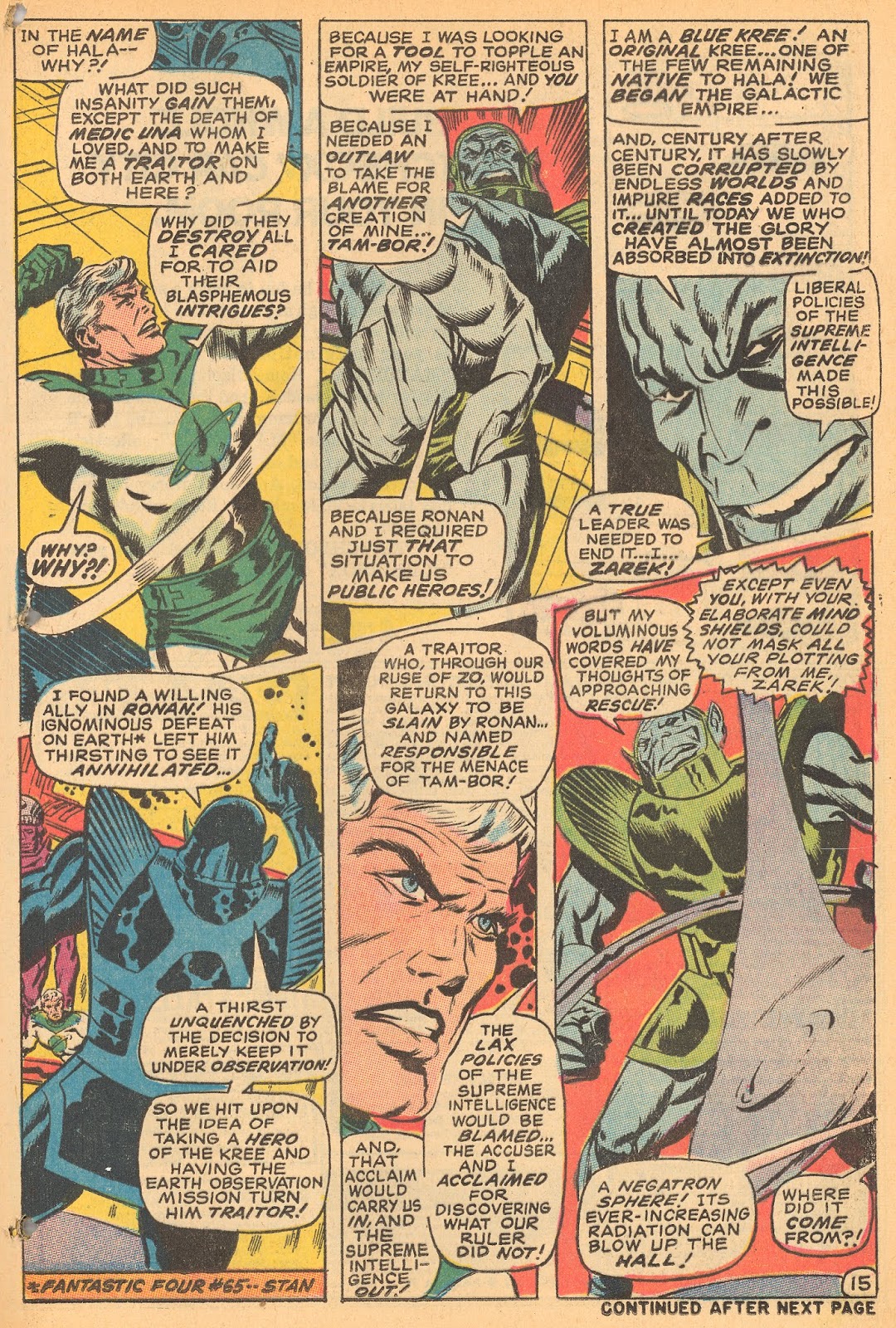
Fantastic Four #65 (August 1967). They had been to earth long ago and planted secret bases and giant robots called "sentries" all over. The F.F. had discovered and defeated a sentry, so this Captain Marvel's first story was about an expedition was sent to determine if the people of Earth were a threat and should be destroyed.
The eponymic hero of this story was Mar-Vell, a captain in the Kree military (get it?). He was the expedition member selected by
Colonel Yon-Rogg, to go to the planet to investigate. Yon-Rogg was was jealous of Mar-Vell and had designs on his lady love,
Medic Una, and thus went out of his way to put Mar-Vell in positions of danger, while Una spent a lot of time weeping over this and calling out Yon-Rogg for his duplicity.
At this point it is hard to describe the character of Mar-Vell without lapsing into synopsis because he changed...a lot.
First he was sent to Earth on his solo mission and checked into a small rural hotel as "C. Marvel." Then Yon-Rogg tried to zap him with a laser from orbit but hit a small plane instead, killing a rocket scientist named
Dr. Walter Lawson. Mar-Vell took the dead man's identity (they looked alike) and reported to work at a US missile base known as "The Cape" (later revealed to be Cape Kennedy/Canaveral, although initially the landscape was drawn as a rocky, mountainous, desert region).
Then he met
Carol Danvers (the future Ms. Marvel/Binary/Warbird/Captain Marvel. We'll get to all that later), head of security at The Cape, who had been suspicious of Dr. Lawson before Mar-Vell showed up. Then robots and monsters attacked the Cape on a regular basis, Mar-Vell kept fighting them off, rescuing Carol Danvers often in the process. Danvers remained suspicious of Lawson, fell for Mar-Vell, while Yon-Rogg plotted against him and made sure Medic Una was aware of every time Danvers made goo-goo eyes at him...and when they kissed.
To cut to the chase, Mar-Vell was used as a pawn in Kree ethnic politics (the blue-skins were pure, the "pinks," like Mar-Vell, were mixed with other races) and got new powers as a result (including space flight and the ability to cast illusions); Una died from a stray laser blast in a battle between the Kree and their enemy, the alien race known as the
Aakon; the late Walter Lawson turned out to be a real enigma that was never solved; Mar-Vell wound up acting like a villain on Earth and had to leave, taking the body of Una and burying her on an asteroid; and when all was said and done, the Supreme Intelligence of the Kree (I'll explain that elsewhere) decided to punish Mar-Vell for disloyal deeds he had done by declaring that he would never rise above the rank of captain, but honored his bravery by letting him keep his new powers and granting him a new uniform.
Unfortunately, within moments of getting that new uniform, his powers somehow sucked him into the Negative Zone...and the readers had to buy the next issue to find out what ground-breaking, galaxy-shattering change Roy Thomas and
Gil Kane would bring to Mar-Vel that would re-define his character forever! (Hint: It wasn't
Snapper Carr)
Very early on, however, Myron Fass, head of MF Enterprises, decided to sue Marvel Comics. The Wall Street Journal is my primary source for this info, and here it is...
To sum up: Fass sued Marvel for trademark infringement, being as he had published a "Captain Marvel" comic first. Martin Goodman had offered Fass $6,000 for his hero character earlier, but Fass had refused. Marvel's defense was simply that their trademark on "Marvel" included all usages of it, including as a superhero name. The article was written at the start of the lawsuit, so it doesn't state the outcome, but at least two sources have stated that it was settled with Marvel paying Fass a few thousand dollars (far fewer thousands than Fawcett had paid DC to settle their suit).
Next: The Magic is Back!




 Posts
Posts


