Amazon ad

Showing posts with label roy thomas. Show all posts

Wednesday, May 8, 2019

The New Beginning for SHAZAM! (Part 12 of the Blog history of ALL the Captain Marvels!)

As we saw in our previous chapter, DC's Crisis on Infinite Earths combined all the heroes on all its alternate universes into one Earth. This enabled them to reboot the entire history of the DC Universe to incorporate the characters of different companies, like Quality and Charlton, that DC had acquired or, like Fawcett, licensed, into one great big world. This meant some interesting shoe-horning and establishing of relationships between characters who had never met before. It also meant that they had to create new versions of their great "trinity" of Superman, Batman, and Wonder Woman. Whereas in the previous Multiverse there were older and newer versions of these iconic heroes on different Earths, now all three were established as having first appeared in modern times, while all the other older superheroes were established as just that, older superheroes, and in many cases, inspirations for the new ones.
    

I could go on about the significance of this and the nuances and quirks that this created, but we are here to look at just one aspect of this: how it affected the original Captain Marvel.

Roy Thomas, a big fan of the World's Mightiest Mortal, had a clause in his contract that said that he would get first crack at any new Captain Marvel project. Now was his chance to do what he had always wanted!

When DC licensed the Big Red Cheese in 1972, it was decided to put him into his own universe, Earth-S, for reasons that included the fact that he was drawn and written so differently from DC's other comics. Now that he was rolled into the regular DC universe, his origin had to be told again. It was told in a four-issue mini-series titled SHAZAM! The New Beginning (April - July 1987)


In this version, written by (Thomas and drawn by Tom Mandrake), Billy lived in San Francisco; the story began with his (unnamed) parents being killed in an auto accident; Uncle Dudley and Dr. Sivana were both Billy's real uncles; Sivana used his kids, Magnificus and Beautea, to trick Billy into choosing him as his new guardian so he could access Billy's father's assets to help his research (he actually arranged the deaths of Billy's parents); and Sivana managed to summon Black Adam from some other dimension.


But of all the differences between this version of Billy Batson/Captain Marvel and the original, the most definitive was that when Billy said the magic word to transform, his mind stayed in the hero's body. His personality did not change to that of a grown man. It is this one change that has stuck with all versions of the character since then (with the exceptions of Jeff Smith's and Earth-5, but we will get to that). It has also become the default assumption of this hero's character to this day.

The effect of this constant personality meant that Billy's passions remained intact when he was a superhero, so his fascination with his new powers affected his initial use of them, and his reaction to meeting Black Adam was that of an enthusiastic juvenile, rather than a grown man with the wisdom of Solomon.

And of course, this being being a new era of "grim & gritty" comics, Captain Marvel's costume had a lot of dark shadows and his driving motivation was that of a dark avenger. This was a big change from the light-hearted, whimsical stories that had been the hallmark of the Big Red Cheese up until then.

Fan reaction was mixed. some liked the new look and feel, others did not. Sales numbers, however, were positive; enough, at least to warrant an ongoing series.

He was a featured hero in the mini-series Legends, written by John Ostrander and Len Wein and drawn by John Byrne, placing him in the forefront of the new lineup of leading superheroes for the new, post-Crisis DC world. He also was a member of the new Justice League team, where his juvenile personality was played for comedy, and the new, "dark avenger" personality was forgotten.


A new, four-part miniseries dealing with neo-Nazis appeared as a backup in Adventure Comics, with a tag at the end promoting a new SHAZAM! ongoing series.

There was a regular series planned and plotted by Roy Thomas. Several issues were scripted. Mary Marvel would be a punk chick older than billy and unrelated. Freddy Freeman would be a black teenage boy in a wheelchair.

The first issue was completely redrawn at least three times, each time  by a different artist and each time not coming up to DC standards. Work was done on the next few issues as well, but somehow, DC dropped the ball on this. The project was never completed, and roy thomas' contract expired.

John Byrne proposed a new series, but it was not picked up. Then Jerry Ordway proposed a new one...

Coming soon: THE POWER of SHAZAM!
Also: THE LEGACY of GENIS-VELL!


Sunday, September 2, 2018

The True History of "SHAZAM!" Mar-Vell, and ALL the Captain Marvels! (Part 4 of several)


When last we left our hero-of-a-certain-name, poor sales had taken its toll, and the publishing frequency of MF Enterprises' Captain Marvel was declining rapidly.

What happened next is not altogether clear. Between Stan Lee and Roy Thomas I have heard or read at least three stories about the creation of Marvel Comics' first Captain Marvel.

The first one I read was in Marvel: Five Fabulous Decades of the World's Greatest Comics by Les Daniels, from 1991. In it, Stan said "I thought it would be terrible if someone else had the name when we were Marvel Comics. After extended legal and business negotiations, we got ourselves the rights to the name, but DC ended up with the old character. I thought we'd better do a book, so I wrote one about an alien from another planet."
Well, Stan is a great storyteller, but is not always the final authority on what actually happened. In this case, DC wound up with the "old character" through a business deal that had nothing to do with the legal action between Marvel and MF Enterprises. We will cover the legal action and the business deal soon.

In Alter Ego magazine and in the introduction to the first Marvel Masterworks edition of reprints of Marvel Comics' first Captain Marvel, Roy Thomas states that it was Martin Goodman, publisher of Marvel Comics, who noticed the MF Enterprises Captain Marvel and decided Marvel ought to protect its trademark and create its own, and handed the assignment to Stan.

Recently Roy Thomas has said to me that he remembered Stan talking at a college and saying that there was a TV deal offered to Marvel for a superhero from outer space named Captain Marvel if Marvel would create the hero. The author Tom Wells, in American Comic Book Chronicles: 1965-69 from TwoMorrows Publishing, repeats this, adding that it was an animation studio's project. I will fill out the details of that story elsewhere.

Whichever is true, or whichever parts of each of those stories are true, on the cover of Marvel Super-Heroes #12 (December, 1967) was a mysterious  new "super-hero": a white-and-green clad figure by the name of... Captain Marvel.

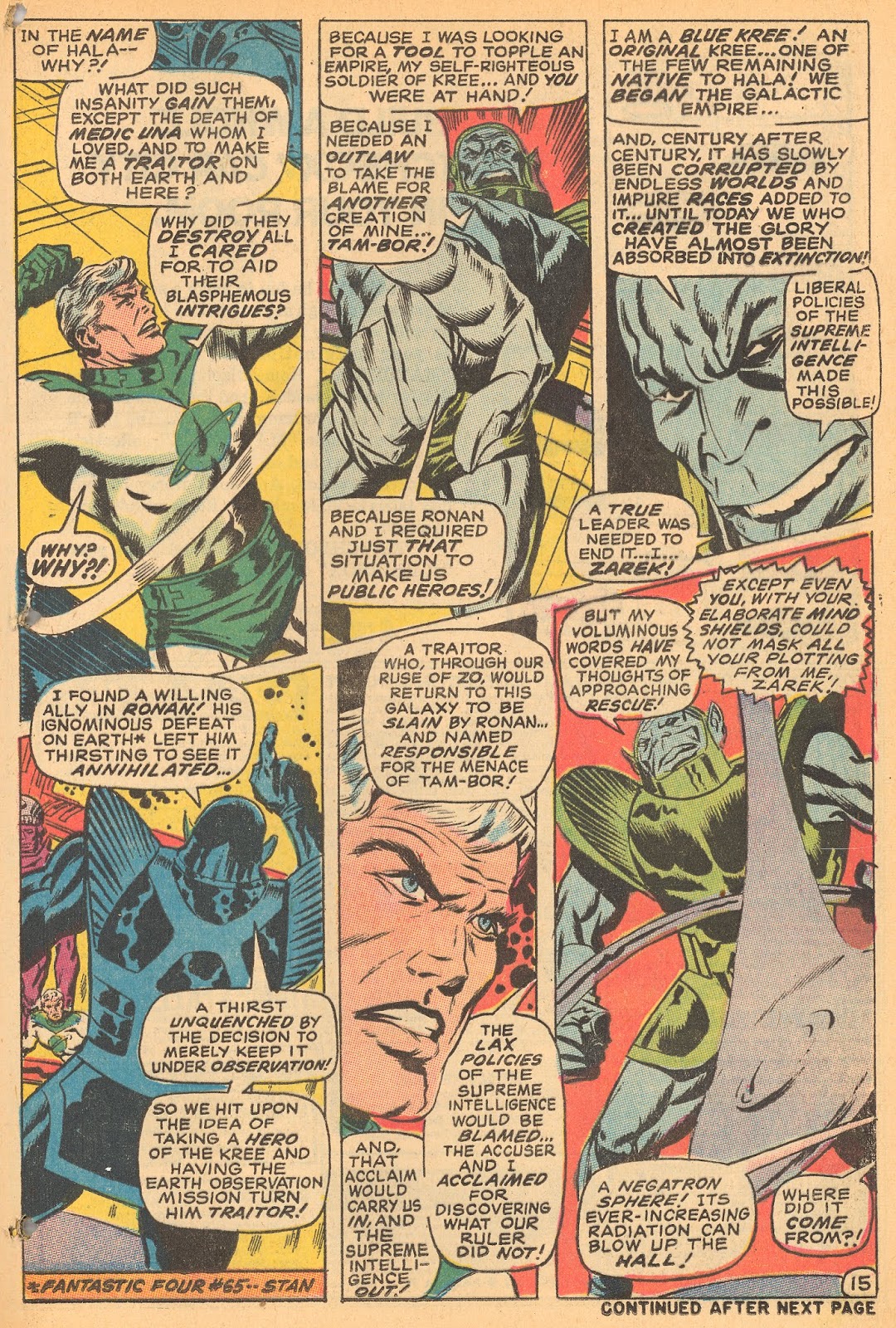
A few months previously, the Kree, a race with a sprawling, militaristic, intergalactic empire, had first been referenced in the pages of Fantastic Four #65 (August 1967). They had been to earth long ago and planted secret bases and giant robots called "sentries" all over. The F.F. had discovered and defeated a sentry, so this Captain Marvel's first story was about an expedition was sent to determine if the people of Earth were a threat and should be destroyed.

The eponymic hero of this story was Mar-Vell, a captain in the Kree military (get it?). He was the expedition member selected by Colonel Yon-Rogg, to go to the planet to investigate. Yon-Rogg was  was jealous of Mar-Vell and had designs on his lady love, Medic Una, and thus went out of his way to put Mar-Vell in positions of danger, while Una spent a lot of time weeping over this and calling out Yon-Rogg for his duplicity.

At this point it is hard to describe the character of Mar-Vell without lapsing into synopsis because he changed...a lot.

First he was sent to Earth on his solo mission and checked into a small rural hotel as "C. Marvel." Then Yon-Rogg tried to zap him with a laser from orbit but hit a small plane instead, killing a rocket scientist named Dr. Walter Lawson. Mar-Vell took the dead man's identity (they looked alike) and reported to work at a US missile base known as "The Cape" (later revealed to be Cape Kennedy/Canaveral, although initially the landscape was drawn as a rocky, mountainous, desert region).

Then he met Carol Danvers (the future Ms. Marvel/Binary/Warbird/Captain Marvel. We'll get to all that later), head of security at The Cape, who had been suspicious of Dr. Lawson before Mar-Vell showed up. Then robots and monsters attacked the Cape on a regular basis, Mar-Vell kept fighting them off, rescuing Carol Danvers often in the process. Danvers remained suspicious of Lawson, fell for Mar-Vell, while Yon-Rogg plotted against him and made sure Medic Una was aware of every time Danvers made goo-goo eyes at him...and when they kissed.


To cut to the chase, Mar-Vell was used as a pawn in Kree ethnic politics (the blue-skins were pure, the "pinks," like Mar-Vell, were mixed with other races) and got new powers as a result (including space flight and the ability to cast illusions); Una died from a stray laser blast in a battle between the Kree and their enemy, the alien race known as the Aakon; the late Walter Lawson turned out to be a real enigma that was never solved; Mar-Vell wound up acting like a villain on Earth and had to leave, taking the body of Una and burying her on an asteroid; and when all was said and done, the Supreme Intelligence of the Kree (I'll explain that elsewhere) decided to punish Mar-Vell for disloyal deeds he had done by declaring that he would never rise above the rank of captain, but honored his bravery by letting him keep his new powers and granting him a new uniform.

Unfortunately, within moments of getting that new uniform, his powers somehow sucked him into the Negative Zone...and the readers had to buy the next issue to find out what ground-breaking, galaxy-shattering change Roy Thomas and Gil Kane would bring to Mar-Vel that would re-define his character forever! (Hint: It wasn't Snapper Carr)

Very early on, however, Myron Fass, head of MF Enterprises, decided to sue Marvel Comics. The Wall Street Journal is my primary source for this info, and here it is...

To sum up: Fass sued Marvel for trademark infringement, being as he had published a "Captain Marvel" comic first. Martin Goodman had offered Fass $6,000 for his hero character earlier, but Fass had refused. Marvel's defense was simply that their trademark on "Marvel" included all usages of it, including as a superhero name. The article was written at the start of the lawsuit, so it doesn't state the outcome, but at least two sources have stated that it was settled with Marvel paying Fass a few thousand dollars (far fewer thousands than Fawcett had paid DC to settle their suit).


Next: The Magic is Back!

Tuesday, November 7, 2017

ASHER ANGEL as BILLY BATSON in "SHAZAM!" (Real News!)


So the casting rumors, speculation, suggestions, etc fall away one by one as another casting choice for DC's "Shazam!" movie is revealed!

As reported in Variety, Asher Angel, Best known in his young career as Jonah Beck in the TV series "Andi Mack," will be playing the young boy who transforms into the World's Mightiest Mortal by saying the magic word, "SHAZAM!"

Not being familiar with his work, I cannot critique the choice on the basis of his acting chops, but he does look the part. Of course, Billy Batson was drawn generically enough that almost any young boy with black hair could look the part (in fact, my trans-gender ex-girlfriend went through a phase in his transition in which he could have played the role - ahem - marvelously).

At age 15, Asher is, of course, the first actual minor playing this role in a live-action film or TV show. The previous two actors, Frankie Coghlan, Jr in "The Adventures of Captain Marvel" and Michael Gray in "Shazam!" were both securely in their 20's when they landed the role.


One thing that will be interesting to me is if Asher and Zachary Levi (who is playing the hero) will be able to sync up their performances to create a believable illusion of the same person inhabiting both bodies. Of course, back in the original Fawcett comics from 1940 - 1953 and the DC comics from 1973 - 1986 Billy Batson and Captain Marvel had separate personalities, though they shared memories. They would refer to each other in the third person, buy each other Christmas presents, and even had an argument at least once! It was only when Roy Thomas created "Shazam! A New Beginning" that the concept of Captain Marvel as a boy in a grown-up's body began. This was after the Crisis on infinite Earths (one of the first big company-wide crossover events in comics) re-ordered the original DC multiverse and put Captain Marvel and Superman on the same planet.

While Roy Thomas played this dynamic for drama, the new Justice League series that came out that year played int for laughs, having Captain Marvel suggest singing "Row, Row, Row Your Boat" as the team grew bored during a long flight, for instance. His juvenility led to him being underestimated in his value to the team, and he left after just a few issues.

Though DC dropped the ball on a continuing series with the World's Mightiest Mortal (a topic for another time), Jerry Ordway picked it up and re-booted the character in 1994 in "The Power Of Shazam!" graphic noel and ongoing series. He maintained the boy-as-adult-hero paradigm, balancing drama and humor. From that point there was going back. The Ordway version became the version that DC maintained until they began the New 52 in 2012. Now the default assumption is of the paradigm is "Big" as a superhero, and every appearance of the character follows that theme.

Several animated cartoon movies and series have done well with that in the balance of comedy and drama, but to me, it is not what the character was originally created to be. The wish fulfillment is that when you say a magic word, you can transform into a grownup! Your mind changes so you can think grown-up thought, handle grown-up situations. It's sort of like "Being John Malkovitch" as a superhero. You exist inside the mind and body of a mighty superhero, sharing experiences and memories, but having the time of your life on not being psychologically tortured like Roy Thomas' invention of Rick Jones and Captain Mar-Vell.

But the director, David F. Sandberg has come out and said that it will be "Big" with superheroes, so I guess that is what we are going to see.

One interesting thing about "Andi Mack" that I just discovered in researching this post is that it is "the first series on The Disney Channel to depict a character coming out as gay" (ABC News). The character of Cyrus on the show, played by Joshua Rush, came out just last month, breaking ground for the youth-oriented, family-friendly network. This adds to a surprisingly long list of connections between the name of Captain Marvel and LGBT culture. This list goes all the way back to the "Adventures of Captain Marvel" 1941 movie serial, in which the role of the wizard Shazam was played by Nigel deBrulier, who was involved in an allegedly all-gay silent film production of Oscar Wilde's Salome, a clip of which appeared in the documentary "Before Stonewall"

One last interesting thing about this casting choice. Just as the hero will be played by a man who shares my initials, ZL, the actor playing Billy Batson shares a birthday with me: September 6! This movie is becoming more and more entwined with me by the week!

And here is the now-traditional "clickbait roundup" of web articles carrying this news...
Collider 
Deadline
comicbook.com
bleedingcool 
Slash/Film
The Hollywood Reporter
MovieWeb
The A.V. Club
cinelinx
Den of Geek
Movie Pilot
Nerd Reactor
Heroic Hollywood
The Wrap
Screen Rant


Saturday, January 21, 2017

Black Adam movie starring Dwayne Johnson announced! (Actual news!)


Well, it looks like the clickbait press has stumbled on some actual news regarding a Captain Marvel-related movie!

As we all know, "Shazam!" is scheduled for an April 5th, 2019 release, and will star Dwayne Johnson (the pro wrestler known as "The Rock") as Black Adam, who has been the most powerful super-villain in the DC universe, and whose origin is tied in with that of the original Captain Marvel.

That's pretty much all we know about this movie. No directors or other actors have been attached to this movie. IMDB reports that Henry Gayden is writing "Shazam!" (the latest in a long line of writers that have been attached to the project since 2003), but no story details have been reliably linked, and no writers for the new Black Adam movie have been named.

A few weeks ago this picture of Johnson and Superman actor Henry Cavill popped up on Cavill's Instagram with a hashtag #DCworldscollide. Since word had been out that Black Adam may appear in a Justice League movie before "Shazam!", it led to speculation that Superman and Black Adam would fight in an upcoming movie.

Johnson had been tweeting about important meetings with movie execs with similarly enticing hashtags, but this news of a Black Adam movie is a big deal, and not a little unexpected.

This would be the first comic book superhero movie headlined by a "bad guy." Of course, Black Adam was somewhat morally ambiguous during much of his run from "Power of Shazam" through the end of the post-Crisis on Infinite Earths, post-Zero Hour universe. This has carried over somewhat in DC's New 52, though with far less subtlety and complexity. It would also be the first time The Rock has been a bad guy on screen, not just in the ring.

There have been at least five versions of the character so far. There was the original, from Fawcett, revived by DC in the 1970's who was unambiguously a bad guy, then the one that appeared in Roy Thomas' "Shazam! A New Beginning," also a bad guy. The one that Jerry Ordway created for "Power of Shazam!" spent time on both sides of the good guy-bad guy divide, which side he was on often depending on your point of view. In the youth-oriented "Billy Batson and the Magic of Shazam" Adam was an emo kid, the kind of villain whose main motivation is revenge. Now the New 52 has maintained that "point-of-view villainy" (the kind where if it were 5000 years ago in Egypt you might think hm a hero, but now he is just mean and sadistic).

Which of these versions of the character the movies will present is unclear, though the "PoS" version is the most currently famous. However, Johnson has talked about how the character is so interesting because he used to be a slave. It is only the New 52 version that had been a slave. It was interesting when Johnson said this because the New 52 was still very new at the time.

In all likelihood, the movie version will be its own animal, with bits adapted from New 52 and PoS. Johnson has talked about bringing "fun" back into the DC universe. This seems kind of odd to attach to Black Adam, as the character was part of arguably the darkest moments in DC comics, history, such as when he murdered an entire country in revenge for the death of his wife.

It's obviously too son for them to say when this now picture will be released, or even if it will come out before or after "Shazam!" some reports are calling it a "spinoff," others that the "Shazam!" movie will now be in two parts. But in any event, it shows that a strong character, with a popular actor to play him, can lead to drastic changes in a movie studio's plan.

Here is your abbreviated (because I don't have time for more) "clickbait roundup":

The Hollywood Reporter (I think on this website it actually counts as "news.")
Variety 
IGN
Screen Rant 
Den of Geek
Rotten Tomatoes
TheMarvelIncBlog (I posted a lengthy comment on this one)
Uproxx
RealityTVWorld
Deadline Hollywood 
Inverse


Saturday, August 16, 2008

The Crisis


By 1986, DC Comics had created two generations of superheroes, and acquired the rights to characters from at least three other companies, Fawcett, Quality, and Charlton Comics. They had explained the existence of these different superheroes by saying they existed in different parallel universes, and they were able to do cross-over stories by having the characters travel between the dimensions.

It was the heroes of the Silver Age that first discovered these dimensions, therefore, their world was called Earth 1. Because the world they first discovered was the world of the original superheroes, that world was called Earth 2. So in other words, the world of the first heroes, the first version of Superman, Batman, Wonder Woman., etc, was Earth 2, and the world of the heroes created or re-started in the 1950's was Earth 1. Confused yet? Just you wait.

There was Earth 3, where the parallel super-powered characters were all villains, and Lex Luthor turned out to be a hero. The Fawcett characters, including Captain Marvel, were on Earth-S (for Shazam). The world where superheroes were all in comic books (ostensibly the world in which you and I live) was called Earth-Prime. This list went on and on.

It was decided that the readers were finding this confusing, so something had to be done. The answer was the Crisis on Infinite Earth. In a long, convoluted 12-issue limited series epic in which almost every single character that had ever been in a DC comic (except for those that were licensed properties, like Jerry Lewis and Mighty Isis) appeared, all the excess universes were destroyed, and most of the superheroes wound up on the same planet. Duplicate heroes, like Superman and Batman, were consolidated, and retconned (retroactive continuity) into not having existed before now, and heroes that were revamps of the originals (Flash, Green Lantern) were generally explained as the elder having been the inspiration for the younger.

So in this world, Captain Marvel existed on the same world as Superman. It was decided to start the series over from scratch.

Writer Roy Thomas and artist Tom Mandrake created a mini-series called Shazam! The New Beginning. It sold rather well, but response was mixed. While some liked it, traditionalist fans of the original World's Mightiest Mortal hated it. The series took place in San Francisco instead of New York, Dr. Sivana and Uncle Dudley both turned out to be Billy's real uncles, and Billy's personality was fully intact when he transformed into Captain Marvel.

A new series was planned that would have drastically re-interpreted the Shazam Family. Mary would now be a wild punk girl, not the sister of Billy, and Freddy would be a black kid in a wheelchair. There were at least three different versions of the first issue drawn, but none seemed to pass DC Comics muster. Captain Marvel was installed as a member of the newly-formed Justice League, but dropped out after a few issues when he got tired of being treated like a kid (even though he was written as one).

Next: Black Light

Tuesday, July 29, 2008

Marvel's First Marvel


History is undecided on what happened next. In Les Daniels' official history of the Marvel Universe, Stan Lee says that he looked around, decided that it would be only right for Marvel Comics to have a Captain Marvel, and engaged in complex legal negotiations to get the name. Roy Thomas, who was assigned writing duties for the character after Stan Lee's first story, states both in articles in Alter Ego magazine and the Marvel Masterworks edition reprinting the first Marvel Comics Captain Marvel stories that it was Martin Goodman's idea, that he had to “protect his investment in the name”...Marvel. One thing is for sure, it was a perfectly reasonable business decision to grab a hold of the name Captain Marvel when your company is called Marvel Comics. There is no end of stories of people assuming that Captain Marvel was a product of Marvel Comics simply by word association alone. In any event, in 1967, Stan the Man created a new Captain Marvel. This one was an alien from the intergalactic Kree empire. He was a Captain in the military and his name was Mar-Vell. He was assigned to spy on Earth and determine if the human race was a threat to the Kree, and thus should be wiped out.

He took the guise of a mild-mannered yet mysterious rocket scientist named Walter Lawson and infiltrated the Cape, a US military space exploration base (they never actually called it Cape Kennedy, which was the name of the US space base at the time, but some years later, in flashbacks, it was referred to as Cape Canaveral). There he earned the suspicions of Carol Danvers, the beautiful female head of security. As he worked with and observed the humans, he began to feel sympathy for them and resisted opportunities to kill them, even fighting to defend them from various threats such as robots and monsters from various sources that seemed to make a habit of attacking the base (using the superior strength of his alien physiology and the superior technology and weaponry of his Kree space suit). In the course of saving the base from these threats, his name, Captain Mar-Vell, came to be pronounced by humans as “Captain Marvel.”

There was also a complex romantic polyhedron going on. Mar-Vell was in love with a medic, Una, on board the Kree ship that was orbiting Earth. She loved him too, but Colonel Yon-Rogg had lustful designs on her, and had a seething hatred for Mar-Vell as a result. Meanwhile on Earth, Carol Danvers was falling for Captain Marvel, who was beginning to develop affection for her, while she was ever suspicious of Walter Lawson, who kept on disappearing at remarkably convenient moments and around whom strange, unexplainable things happened.

Put all this together, and you had a character who was in many ways, more like Superman than the original Captain Marvel. An alien from outer space with powers and abilities beyond those of mortal men, who disguises himself as a mild-mannered person, then slips away to change into his heroic costume and save the world. He had a hyphenated name that ended with “el.” He even had a Lois Lane parallel in Carol Danvers, who incidentally has the same last name as Superman's cousin, Linda Danvers, Supergirl (Roy Thomas, who created her, insists was an accident).

Stan Lee likes to justifiably boast about the seemingly magical success about every one of his creations from the 1960's. However, in his autobiography, there is not a single mention of Captain Marvel. Whether he forgot, or was embarrassed, the fact is that his Captain Marvel did not sell as well as most everything else he created in the 1960's. Gene Colan, who designed the uniform and drew the first few issues, said it was the worst superhero costume ever.

Captain Mar-Vell first appeared in the pages of Marvel Comics' compendium book, Marvel Super-Heroes, and after two issues, he got his own book. However, after a year of repetitive stories, there began a series of plot devices and shark-jumping changes galore. Unfortunately, none of these changes really were able to grab a loyal audience.

Both his love-interest, Una, and rival, Yon-Rogg were killed, he was used as a pawn in Kree politics, got swept up in racial conflict within the Kree Empire, then ultimately was given new powers, a new costume, and then unceremoniously dumped into the Negative Zone. Then Rick Jones, Marvel Comics' official all-purpose sidekick (yes the kid who got Bruce Banner turned into the Hulk), found a pair of golden bracelets called “nega-bands,” and by banging them together, found he could trade places with Captain Mar-Vell in the Negative Zone. This was a new take on the Billy Batson/Captain Marvel transformation. This time, instead of it being a strict transformation, where the alter-ego was subsumed by the superhero and vice versa, the alter egos were actually able to communicate with each other, essentially living in each other's heads.

But the biggest change for Captain Mar-Vell was when, in 1973, Jim Starlin wrote and drew a storyline that had Mar-Vell being chosen by the cosmic entity Eon to be the Protector of the Universe and granted Cosmic Awareness (the ability to be aware of absolutely everything in the universe, past, present, and future. A handy ability, and one that can give great serenity to one who has the mental and emotional stability to handle it). This turned the alien warrior into a cosmic space hippie, very much a product of his times.

Despite this, and a very concerted effort by Marvel Comics to identify this Captain Marvel as one of the front-line heroes in its universe, the title was eventually canceled in 1979.

Next: Don't Miss the Ms.!