Amazon ad

Showing posts with label mary marvel. Show all posts

Wednesday, June 3, 2015

Shazam: Convergence review part 3

(continued from previous post)...Of course, a "by the numbers" adventure with the Marvel Family is still fun (especially when you add Mr. Taawny in an open-cockpit WWII fighter plane). And the subtle combination of the lighthearted elements of the Shazam heroes and villains with some logical character explorations and the deeper, darker dimensions of the Multiverse was handled with great skill, allowing the reader to enjoy the ride while appreciating the depth.


But as I said, a great opportunity was missed here. Gotham by Gaslight, on its face, appears to be a drastically different world than that of what DC called "Fawcett City" on Earth-S or Earth-5. It is a dark, scary, treacherous, mysterious, well...Gothic...place. However Billy, Mary, and Freddy are not actually strangers to such a world. On several occasions, both individually and as a family the Marvels found themselves in such environs, Freddy in particular lived in a quasi-gothic evnironment, especially when drawn by Mac Raboy. He dressed in rags, lived in a run-down boarding house, and often found himself defending orphans, waifs, and even magical fairy creatures that would not be unfamiliar to a Victorian audience.

It would have been interesting to see the Marvel Family deal with the challenges of a dark Victorian, steampunk adventure in a full-length story. In their human selves, I could see Billy, the young adventurer, intrepidly seeking clues, while Mary, the adopted daughter of privilege, and Freddy, the poor orphan boy, being concerned with the welfare of the downtrodden. As their heroic personas, Captain Marvel would be initially perplexed by the mysterious ways of the creatures of darkness, Mary Marvel would be drawn to the plight of the underclass, while Captain Marvel Junior would use his familiarity with the environment to start to see the solution. Together, their wisdom and courage would see them through. It's quite possible their strength, speed, and abilities would help the Batman of this world solve a mystery that had eluded him, and perhaps, in a more ambitious tale, would even help him solve a particular social evil.

But this was just a one-time, two issue story that was part of a bigger, company-wide, crossover epic. We will probably never see this combination of characters and worlds ever again (outside of fan fiction, of course). In time, it will be reprinted in a trade paperback collection, perhaps a giant omnibus edition, but it is unlikely that it will be one of the Great Epic Tales that will be remembered in the annals of comic book history.


So we will see what DC will do with the former Fawcett characters in whatever world will emerge from "Convergence.." I hope they will return these characters to their roots with their original names, powers, and characteristics. They cave the DC universe a lighter touch and needed balance when things got all grim 'n' gritty in the 1990's. I prefer that Billy and Cap have separate consciousnesses, but if they must have the same mind, at least have Billy be the kind of kid to whom you would want to give superpowers. If you want to have a troubled kid find redemption, make up a new character. You could even have him be in the "Shazam" family, but let the first, the original, the leading Hero of the Word be a brave, pure, good soul to set an example for the rest.

Friday, May 29, 2015

"Shazam" Convergence review part 2

Because nobody who reads comics can possibly expect anything in one comic book by one company to not affect anything in any other comic book by that company (and maybe other companies as well), when change happens, it happens big. Also, when you make a big change that affects every character in every book that you sell, everyone is going to have a reason to buy the book that month, and possibly other books as well.

This has been a guiding principle of the major companies that produce superhero comics since the 1980's; every few years try to raise the stakes and come up with the GREATEST, MOST AMAZING, REVOLUTIONARY, MIND-BLOWING CHANGE EVER! This week it was "Convergence."

So we got these 52 universes, right? So instead of letting them exist and visiting them occasionally, let's BLOW THEM ALL UP IN A MASSIVE CROSS-OVER BATTLE EPIC!

So DC has revived the heroes and villains of various past titles, storylines, and alternate universes in its history and mashed them together in titles that place them in conflict with each other. In the case of the classic Marvel Family (aka: "The Shazam Family") they get placed in conflict with the world of "Gotham by Gaslight," a late-Victorian version of Batman that has come to include such genres and tropes as Gothic horror, German expressionism, pulp adventure, and steampunk.


The two-part mini-series "Convergence: Shazam," written by Jeff Parker and drawn by Evan "Doc" Shaner, starts on Earth-S, or at least that's what it says inside the front cover of the comic. The world is much like that in the DC "Shazam!" stories between 1972 and 1985, with all the same characters (Billy, Mary, Freddy, Uncle, Mr. Morris, Tawny, etc) and there is plenty of "fan service" in things like brand names and background characters. The villains are classics, (Dr. Sivana, Mr. Atom, King Kull, Ibac), and reference is even made to the suspendium trap and the Marvels' 20-year absence.

There are differences, though. It is implied that Mr. Morris was not in the suspendium trap, while in fact, on Earth-S, he had been.  There was no Fawcett City on Earth-S (unless you count that one issue of "All Star Squadron" in which Roy Thomas first named Billy Batson's hometown), the original home of the Big Red Cheese was always unnamed, but assumed to be New York. But these are nit-picks that only some sadly over-passionate fan would care about or even notice...

The art is remarkable. It appears to be an almost photo-realistic interpretation of the original characters, but with enough detail left out to give the feeling of C.C. Beck's deceptively simple-looking art from the Fawcett days. As such it seems like a logical progression of where the art would be had the series continued under the same management over the decades (a look at recent versions of "Archie" shows a similar evolution, especially in certain "alt-Archies" like the zombie-horror series "Afterlife with Archie."). All the characters maintain their distinguishing characteristics and are instantly recognizable, but the drawings look like they were taken from life, as if they found the perfect actors for each character. This shows both the skill of the current artist and the brilliance of the original, to be able to interpret the cartoony drawings into recognizably realistic people and to create cartoony drawings that could be interpreted so.

The first issue stayed on this world, and the second one moved into the world of gaslight Gotham. But before it did, the first page of issue #2 declared that this world, that of Fawcett City, was Earth-5.

CONTINUITY VIOLATION ALERT!

EARTH-5 IS NOT EARTH-S!

As I mentioned in the first part of this review, It was publicly stated that Earth-5 is not Earth-S. This can be confirmed by looking up Wikipedia and DC Wiki (note the separate listings for Earth-S and Earth-5). A couple of notable but important differences are that in Earth-S Mary Marvel has a red costume, while in Earth-5 her dress is white, and that the "Seven Deadlies" in Shazam's throne room are "Enemies of Man," while on Earth-5 they are "Sins."

Speaking of Mary's costume, in the "Convergence" stories she is wearing a mid-length-skirted, short-sleeved dress in line with her costume in Jerry Ordway's "Power of Shazam" series that is a compromise between the short-skirted dress in which she originally appeared and the full-skirted, puffy-sleeved dress she wore for most of her Fawcett years. In any case, she is not wearing the short-skirted dress in which the Shazam-bolt descended from her neckline and the cape was mysteriously attached with no cord as she did in her later Fawcett years and all through her pre-"Crisis on Infinite Earths" tenure at DC, which is Earth-S, for all intents and purposes. She is also wearing boots, not slippers, as she would have in that period.

When the story moves to Gotham (or, as the promotional blurb would have it, "Shazam meets steampunk"), Shaner's graphic style and the colors by Jordie Belaire effectively convey the Gothic Victorian gloom of the gaslight city. There is fan-service galore, if you know what to look for, all through the story, from Mary Marvel catching a bomb to Killer Crock hurting himself trying to attack Captain Marvel (geek points if you can name the inspirations of those references). The story spends precious little time in that world, however, and almost no time with Batman. It's as if the ostensible co-star of the whole two-issue story was really more of a guest-star, a supporting character, barely more than a cameo.

But the unexpected money-shot for me was one two page spread in which Captain Marvel and Billy Batson spoke to each other in the instant between the transformation.

The hero had been zapped by electrically-produced lightning from gaslight Gotham. Apparently the charge, though not magical, was strong enough to effect the change. In a conversation that must have been going on inside their minds, the two characters, the hero and the boy, recognize the situation and try to figure out what to do about it. This established what I had always believed, and what was clearly intended, for the characters from the beginning: Billy Batson and Captain Marvel are separate characters. They share memories, but they are each distinct personalities. The Shazam/Captain Marvel concept is not "Big" as a superhero, it is a boy who has the ability to transform into an adult superhero by saying a magic word.

This was the high point of the story as a piece of superheroic fantasy for me. But sadly, beyond that, it was pretty much by the numbers. This is unfortunate, as there was so much more that could have been explored with this combination of elements... (to be continued)

Thursday, May 28, 2015

"Shazam" Convergence Review, part 1

After having been out of the comic book market for a month and a half due to my trip to the medieval combat world championships (my documentary of the USA Knights is coming soon) so I finally got a chance to catch up on the whole "Convergence" thing happening with DC Comics and the role of the original Captain Marvel in it.

It started, if you will, with the "Multiversity" event, a storyline in which the different universes of the "New 52" were explored, some being developments of "Elseworlds" concepts from years ago, some being brand new interpretations of DC characters and superhero tropes, and one being a new interpretation of the classic hero and his word from Fawcett Comics.

As regular readers of this blog know, the original Captain Marvel was acquired by DC Comics in 1972 and his stories began pretty much where they left off, with an explanation of how the Big Red Cheese, Junior, Mary, the Sivanas, and most of the other back-up characters had been trapped in a vessel of "suspendium" for 20 years. DC also explained that these characters existed on "Earth S," a parallel Earth in which the regular DC characters did not exist. After the "Crisis on Infinite Earths" of 1986, all the alternate universes were combined into one, and some major characters, including the Big Red Cheese, were "rebooted" and given slightly different interpretations.

Then the New 52 hit in 2012, and DC rebooted their entire universe and every character in it. They established that there are 52 alternate universes and implied that there was an "Earth 5" that appeared to be a copy of Earth S (5 = S, get it?).  It was stated publicly, however, that Earth 5 was not Earth S and that we would find out, someday, what it was.

What it was was revealed in the Multiversity one-shot "Thunderworld." This was a fun, entertaining romp written by Grant Morrison and drawn by Cameron Stewart that introduced the world of Earth 5, in which the Marvel Family, with the help of Tawny, Uncle, and the Lieutenant Marvels defended Fawcett City from the Sivana Family and the Monster Society, as Dr. Sivana captured the Rock of Eternity and stole enough suspendium with the help of alternate-universe Sivanas to create an 8th day of the week. It was a brilliant combination of the hokey ficto-science and adventure of the classic Fawcett stories with multi-cosmic and, frankly, disturbing elements of Multiverse.


In "Thunderworld," the re-interpretations of certain classic elements (The Lieutenant Marvels now included Uncle and Tawny and were a uniformed, rocket-packed, sci-fi-weapon-bearing squadron, and Billy used a cell phone with his updated backpack broadcasting equipment) were handled lightly and not out of character with what one might expect from an organic progression of the characters from the 1940's. Dr. Sivana's motivations were consistent with the character, making him the perfect character to begin to explore the evil implications of a multiverse. The conclusion gave us a perfectly satisfactory twist and a closing that was consistent with anything Otto Binder ever wrote. The whole story was applauded by the great majority of fans of the World's Mightiest Mortal, and we all wanted to see more.


So when "Convergence" was announced, we waited with bated breath to see how it would turn out...

Thursday, January 15, 2015

Original "Shazam!" Captain Marvel Converges with Gotham by Gaslight!


DC Comics has just announced an appearance of the "Earth S" Captain Marvel, the original from Fawcett publications 1940-1953 and DC Comics 1973-1986.

This will come as part of the "DC Convergence" event in which many of the universes created by DC Comics, including those of characters from other comics companies that DC has acquired, the alternate universes that explained the difference between "Golden Age" and "Silver Age" characters, the post "Crisis on Infinite Earths" universe, their many "Elsewords" universes, and the "New 52." I week 4, there will be ten titles released, each of which involves the crossover of two universes. Of interest to this blog is the title "Shazam!"

In this issue, the original Captain Marvel will crossover with the world of "Gotham by Gaslight," a gothic/steampunk word of a late Victorian era Batman.

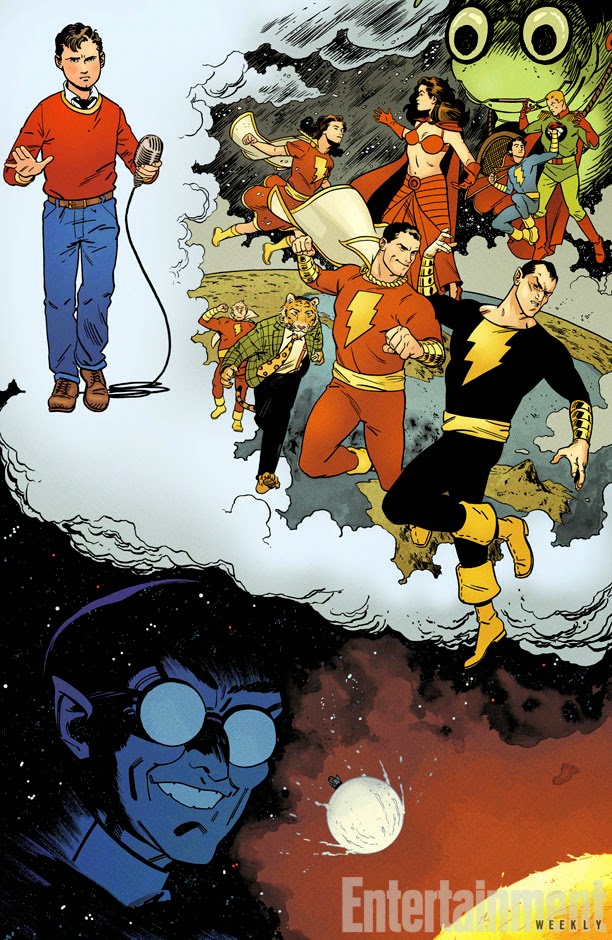
This is not completely out of the realm of something that the Big Red Cheese would do. Many times in the Fawcett years did the hero, and many times Mary and Junior too, travel through time. The contrast of the "sunny" Captain Marvel with the dark, brooding Batman should prove to be an interesting combination, and if the preview art is to be believed, it looks like we will be seeing the rest of the Marvel Family as well as Mr. Tawny, and favorite villains like Black Adam, Mr. Mind, Captain Nazi, and Dr. Sivana. There is also one female villain that I don't recognize. Am I missing her from my knowledge of the original Fawcett universe, or is DC creating a new villain for this story?

The preview listing is the eighth title down on this page...
http://www.newsarama.com/22861-dc-s-convergence-week-four-pre-crisis-multiverse-is-back-baby.html

Tuesday, October 16, 2012

Marc Swayze, 1913 - 2012

RIP Marc Swayze. He was one of the last, if not THE last artist alive who drew the original Captain Marvel for Fawcett publications. I designed the look of Mary Marvel and drew her first adventures. He had a regular column in the "Fawcett Collectors of America" section of Alter Ego magazine titled "We Didn't Know It Was the Golden Age." He was close friends with P.C. Hamerlinck, the publisher of FCA. He will be missed.

Thursday, September 30, 2010

New CMC Ashcan!

As I am continuing to seek sponsors for this project, I have produced a second ashcan issue of Captain Marvel Culture. The first issue covered the period from the dawn of human art to Marvel's first Captain Marvel. This second issue will cover the introduction of Rick Jones up to "Power of Shazam."

These ashcans editions will also contain other, non-Captain Marvel-related writings and art by Yours Truly, as well as information for potential advertisers. your purchase of these editions will help finance the project.

I am on schedule right now to have these two editions available at the Big Apple Comic Con happening this weekend, Oct 1-3, at the Penn Plaza Pavilion in NYC. I will also have a beautiful and talented actress portraying the golden age Mary Marvel, who will be competing in the costume contest in the Affinia Hotel Ballroom at the end of the day on Saturday.

The convention itself will be an awesome affair, with comics creators liek Joe Simon, Carmine Infantino, Jerry Robinson, Mike Grell, Mark Millar, Arthur Suydam, Irwin Hasen, Billy Tucci, stc, and celebrities sich as Lee Majors, Mary McDonnell, Adam West, Burt Ward, Claudia Christian, Erin Gray, Walter Koenig, and more.

You can find out more about it at http://www.bigapplecon.com

So if you can get to NYC this weekend, don't miss it!

Thursday, August 20, 2009

Help finance this project - Buy my posters

Hi Friends. I have just finished an article about the female Captain Marvels for Alter Ego Magazine. It should be out in the October or December issue.

On a related note, I am raising more funds to finish off this project by selling off some things that I no longer need, some pieces of my life that I am leaving behind. I used to collect posters. At every comic convention, every free giveaway, every movie premiere, if they were giving away posters, I would take some. Some had been given to me as gifts, some I even sought out and bought. But now they are just taking up space, cluttering up my room, and not doing me any good. I don't have the wall space for them, and besides, I'm not a kid anymore.

So who wants about 300 posters from the 1980's up to today? Mostly they are movie posters, sci-fi and fantasy, although some of them are for comics, books, games, sports, art, music, and I even have a few that have the World Trade Center in them. I don't have the time to put them all up on E-Bay, so I will accept any reasonable offer, so long as you either come to pick them up or pay for shipping.

You can see photos of them all at http://s846.photobucket.com/albums/ab21/captainzorikh/Posters/

Below is the list of what's available:

Movies & TV
300 DVD (3)
Alien Raiders (small) (3)
Alien Raiders (4)
Apollo 13 (2)
Babylon II (2)
Beowulf (2)
Black Dahlia
Blade Runner- National College Preview (2)
Blade Trinity 1
Blade Trinity 2
Boogeyman (2)
Braveheart weapons
China O'Brien 2
Cloverfield
The Core
Cutthroat Island
Daredevil – Ben Afleck
Daredevil – Bullseye (2)
Daredevil - Elektra (2)
Daredevil – Kingpin (2)
Darkman (3)
Dead Presidents
Deadly Spawn (6)
Death Prof & Planet Terror/Death Proof (2)
Death Proof & Planet Terror/Machete (2)
Doomsday (2)
Dragons – Animal Planet (William Stout)
Eight Legged Freaks (3)
El Cantante
Escape From L.A.
E.T. 20th Anniversary (5)
The Exorcist (remake)
Face/Off
Fanboys (6)
Fido
Final Destination 2 (2)
Flyboys
The Fourth Protocol (3)
Ghost Ship
Golden Compass
Grant Morrison's MBX (online animated)
Harry Potter Soundtrack
Hellboy (small) (2)
Hellboy (big)
Hellboy II
Hell's Beacon (signed)
Highlander/The Cutoff (Karate International) (2 sided)
House of the Dead (2)
The hunchback of Notre Dame (Disney)
Indiana Jones (4)
Into the West – TNT (2 sides) (2)
Iron Man (launching) (2)
Iron Man (4)
Iron Man (2)
Jackass 2
The Jacket (2)
James Scott (audio play)
Jurassic Park – The Lost World (2)
Kill Bill (3)
Kull the Conqueror (3)
LifeForce (9)
Lord of the Rings – Two Towers (small) (2)
Lord of the Rings – Two Towers (big)
Lord of the Rings – Return of the King – Gandalf
Lord of the Rings – Return of the King - Frodo
Master and Commander (2)
Master & Commande (2 sided) (2)
McHale's Navy (4)
Millenium Actress (2)
Mongol (59)
Mr. Ed Salad Bar – Nick at Night
Ninja Babes from Space (2)
One Piece (2)
Pathfinder (2)
Perfect Creature (2)
Punisher 2004 (Skull) (2)
Punisher 2004 (Thomas Jane) (3)
Punisher War Zone
Red Planet
Remo Williams: The Adventure Begins (2)
Remo Williams: The First Adventure (6)
Return of the Aliens: The Deadly Spawn
Robin Hood: Men in Tights (7)
The Rock
Rollerball (remake) (3)
Sci-fi Channel (2)
Scorpion King (8)
Seeing Red
Silence of the Lambs
The Sixth Day (3)
Slacker Cats
Slayer (3)
Stardust (2)
Stargate - Ark of Truth
Star Trek Nemesis (4)
Star Trek 2008
Star Wars – Revenge of the Brick
Star Wars – The Phantom Menace – Taco Bell 1 of 4 (with coupons)
Star Wars – The Phantom Menace – Taco Bell 2 of 4 (with coupons)
Star Wars – The Phantom Menace – Taco Bell 3 of 4 (with coupons)
Sweeny Todd – Depp (2)
Sweeny Todd – Depp & Carter (2)
Tales of the Broken Moon
Timeline (3)
To the Devil – A Daughter (2)
Tomb Raider soundtrack
Tomorrow Never Dies
The Tune (singed & personalized by Bill Plympton)
Transformers (2)
Twilight (2)
Underdog
Underworld (2)
Urban Legends - Final Cut
War of the Wizards (11)
War of the Worlds
Watchmen - Silk Specter (5)
Watchmen – Comedian (2)
What About Bob
X-Men (2)
X-2 (3)

America Film Market 1989
America Film Market 1990
New York International Independent Film and Video Festival 2005 (2)

Theater
It Ain't Nothin' but the Blues

Books
Hatter: The Looking Glass Wars - (2)
Star Wars – Legacy of the Force
Tigerheart (Peter David) (2)
Waldenbooks Other Worlds Club

Comics
100% - Vertigo
2001 Nights (3)
Arrowsmith
Batman Adventures
Big Daddy Danger - DC
Black Dragon
Black Tiger
Chronicles of Sara
DK2
Feather
The Filth – Grant Morrison – Vertigo (2)
Fables
Galtow
Helix Comics
Human Target - DC
JLA: Obsidian Age
Magnus Robot Fighter – Aklaim
A Man Called Ax – DC (3)
Marvel in Previews
More Than Mortal Sagas
Ninjak – Aklaim
The Pummeler
Replacements
Savage Swod of Conan
Sin City
Spiral/Black God
Troublemakers - Aklaim
Turok - Aklaim
The Warrior's Way
Wonder Woman: The Hiketeia – Original Universe
Warrior's Way
Will Eisner Tribute
WS: Eye of the Storm - Wildstorm
Zombie Loan/Alice on Deadlines

Big Apple Convention September 2005 10th Anniversary (Arthur Suydam) (3)
Big Apple Convention November 2007 (Brian Kong)
Big Apple Convention June 2008 (Michael Golden - Iron Man) (16)
Creation Convention National Tour 1983
MoCCA Art Fest 2005 (2)
Whitney Comic Art Show 1983

Computer Games
Asheron's Call (2 sides)
Dragon Age Origins (2 sides) (24)
Lair (3)
Lord of the Rings: Return of the King
Middle Earth – The White Hand
Tenchu
Warhammer Online Age of Reckoning (2 sides)

Non-Computer Games
Andromeda 2500
Dragon Quest
Kult – Illusion #1, 1994
Shadowstar Games
Sorcerer's Crusade
Who's Who Among Vampires – Children of the Inquisition

Toys
Batmobile 1950's
Justice League
JLA – Starro
Superman #14
Watchmen

Art
Architecture calendar posters (2 different)
Architecture in Congrass 2000 - 1985
Cheshire Cat
Dragan Ilic
Dragan Ilic signed & numbered (1 of 100)
Excedrin 1
Excedrin 2
Wavertree ship in South Street Seaport
Heavy Metal (Royo)
Red Grooms Grand Central Terminal (signed & personalized)
Salute to Brasil 1979
Sagres – Portuguese ship
Sci-fi – Columbia House
Space

Sports
Boxing - John Duddy vs. Dupre Strickland 5/18/2007
Boxing - Tyson - Holyfield 11/9/1996
Dr. J – Converse
Football Cards, uncut sheet
International Fight League
NASCAR Sprint Cup 2008
New Jersey Red Dogs Arena Football 1999
New York Knights Arena Football 1988 (3)
Pepsi-Gatorade (2 sided)
Tommy Moe-signed
USA Basketball “America's Team” 1992
Super Bowl XV – New Orleans

Music
The Beatles First US Visit
Hudson River Revival 1986
Apocalygma Berzerk
Battery Cage
Bella Morte
Imperative
KMFDM
Psyclon 9
Retrosic
Seabound
System Syn

Other
Cindy Crawford in fantasy armor - Pocari Sweat (Japan)
D-Day 50th Anniversary (3)
Famous Grouse “Henge” scroll
Famous Grouse map of Scottish whiskey distilleries
Head of Charles Regatta
“Marihuana” Warning
School of Visual Arts – Churchill & Eiffel Tower
School of Visual Arts – Imagination Birds
Stuyvesant Scroll
Taco Bell “80's, what a Decade” 1990 calendar
Timespell (Multi-media show in Watkins Glen, NY)
Tower Records book covers (2)
Tower Records calendar 1987 (3)
Tower Records calendar 1989

Most of the posters are in great shape, though some are a little battered from having been up on a wall or in transit.

If you are interested, contact me at zorikh@juno.com or 917-865-1214

Thursday, September 18, 2008

Funny Papers and Moving Pictures

Meanwhile, Jeff Smith, award winning creator of the Bone comic book series, has created a new Shazam story, again rebooting the original Captain Marvel franchise, in a mini-series using the title of the old Fawcett serial, “Monster Society of Evil.” Though he made his own adjustments to the canon, for instance making Mary Batson a much younger sister, and Mary Marvel the same apparent age as Mary Batson, and making Tawky Tawny a magical changeling whom Billy knew as a homeless man, and making Mr. Mind a monstrous alien, rather than a brilliant evil little worm, his version did prove that DC is willing to give Captain Marvel a chance at something with a look and feel that is more light-hearted, youth-oriented, and with a more “cartoony” drawing style. This willingness has been extended to a new book by Mike Kunkel, Billy Batson and the Magic of Shazam! In DC Comics' Johnny DC youth-oriented line.

There has also been, for the past few years, a Shazam! movie on the slow track for production at New Line Pictures with Michel Uslan producing. The script has gone through several writers, including William Goldman and Joel Coen & Alex Soklow. Currently John August is writing the script, with Peter Segal signed to direct. Movies based on comic book characters have boomed lately. The quality and popularity of comic book-inspired motion pictures has been notoriously hit-and-miss since the Superman movie of 1978, but several low-budget movies based on independent characters in the early 1990's proved that when done with respect for the source material, a movie based on a comic book can be good and find its audience. Since then, the recipe for success has been to listen to the fans and find a producer-writer-director team that will serve the material well, rather than simply treat the material as a property to exploit. New Line has been working with PC Hamerlinck, publisher of Fawcett Collectors of America.

In a recent example of serving the audience, MTV Blogs appears to have influenced the casting of at least one character. Rumors had arisen years ago that Dwayne Johnson, the pro wrestler known as The Rock, would play the Big Red Cheese. Fan response was largely negative, some because they doubted his acting ability, some simply because Captain Marvel was never portrayed as half black-half Samoan. Some (including Yours Truly) suggested that he might be better as Black Adam. In late 2007, MTV Blogs held a survey asking whether Johnson should play Captain Marvel or Black Adm. The result was an overwhelming response in favor of Black Adam. So Johnson went public saying he would listen to the fans and would be glad to talk with New Line about playing Black Adam.

Next: Marvel...The Return

Sunday, September 14, 2008

The Latest from DC, part 1

Lately, DC Comics has gone in two different direction with the original Captain Marvel. In the main DC Universe, they have decided to totally re-imagine the character, at least in part to differentiate him from Superman. Since the beginning these two characters have been at loggerheads. Both of them are super-strong, invulnerable, and can fly, and are the greatest heroes in their respective universes. When they wound up in the same universe, a logical question was “what do you need to have both heroes for, when each of them can do pretty much what the other one can?”

The answer, for DC Comics, has recently been to play on one key difference between the two: Superman was a science fiction concept: an alien from outer space with powers far beyond those of mortal man. Captain Marvel was a product of magic: a hero with the abilities of a half-dozen mythological and legendary characters.

In the ongoing trend of having a mighty, company-wide crossover event every year to drive collector and fan excitement about the company, as well as, yet again, “cleaning up” some of the messiness in the DC Universe left over since the last big “clean up the DC Universe” event, Zero Hour, DC Comics brought forth Infinite Crisis.

In the lead up to this event, Days of Vengeance, the magical element of Captain Marvel was brought to the fore. Captain Marvel was used as a focus of all the magic in the universe, as every magical character focused their energy on the Captain so he could grow in stature to battle the Spectre, a magical, god-like being that had, ironically, been created by Jerry Siegel back in 1939. He wound up losing the fight, though. Also in the story, old Shazam died and the Rock of Eternity was destroyed.
By the end of the Infinite Crisis, it was established that there were now 52 parallel universes. The “post Crisis on Infinite Earths” universe remains, and most of the old DC Universes (Earths 1, 2, 3, etc) seem to have been recreated, as well as self-contained universes for the characters of each company that they have acquired (Earths S, X, etc.). This now allows DC Comics to create stories with the characters in their original universes, if they ever choose to do so.

The Rock of Eternity had been rebuilt, and Billy Batson was installed there to keep an eye on the magical world, as the Rules of Magic have been “rewritten.” In other words, Captain Marvel became the top cop for magical monsters and demons. Before that could be explored further, however, something happened. Billy Batson said “Shazam” one day and the Captain Marvel he transformed into was different. He was in a white version of the Marvel suit, his hair was long, straight, and white, and his cape was long and had a hood. He looked like Elric of Melniboné, Michael Moorcock's magical albino, on steroids! At the same time, Captain Marvel Jr. and Mary Marvel both instantly lost their powers!

It turns out that Billy Batson/Captain Marvel is now to sit on the throne of Shazam. Billy Batson looks to never be seen again, and the character simply uses the name “Marvel.”

Freddy Freeman, the Shazam Family outsider, and former Outsider (since losing his powers) has been set on a quest to earn each individual power of Shazam (Solomon's wisdom, Hercules' strength, Achilles' courage, etc.) in a series of trials chronicled in the recent series Trials of Shazam. One result of these trials is that the hero who will ultimately say the magic word and wear the red suit with the gold lightning bolt (Freddy Freeman) will be called Shazam. Dan Didio, editor-in-chief of DC Comics has admitted that part of the reason for this is to finally have a comic book with the character who's name is the same as the title.

Mary Batson, after recovering from injuries sustained when she lost her powers, fell into a fit of depression, sought to regain her powers, and met Black Adam. He gave her back access to the Power of Shazam, but also a share of his powers. This made her more powerful and and gave her a greater range of use of magic, and she gained a new costume, a black, long-sleeved, capeless number with a very short skirt.. Once the moral center of the Shazam Family, she fell to the temptations of that power, almost becoming a tool of the villain Eclipso. She overcame that temptation, however, when she realized that she was being used, and lost her powers again. She regained her original powers (and a new white costume with long sleeves and a gray lightning bolt) when she realized that what she really wanted was to help people with her powers. Then the villain Darkseid tempted her with the powers that she had gained from Black Adam and debates of moral relativism, and Mary accepted them, and the black costume reappeared.

Friday, August 22, 2008

The power of...the Ordway!


In the early 1990's, comic books were enjoying an unprecedented boom in sales and creativity. The fight for creator's rights had a breakthrough when several high-profile artists for Marvel Comics left and formed a new company, Image Comics. At the same time, a new company, Valiant Comics, also made up of former professionals from Marvel and elsewhere, appeared on the scene.

At the same time, the comic book industry had started to really play to the collector's market. Gimmicks such as variant cover editions, canceling books and starting them with a new “first issue,” packaging comics in plastic bags with trading cards in them, foil-embossed covers, and the star treatment given to hot new artists were driving collectors and fanboys to buy multiple copies of many comics.

The mainstream public had long been growing in awareness of the collectible value of comic books. Now many people were buying comics with no intention of reading them, merely storing them until the could, theoretically, sell them at a vast profit. With so many people buying comics, new comic book shops were opening all over the place. Businesses that had never sold comics before were now selling comics. One neighborhood in Brooklyn had a glove manufacturer, a laundromat, and an auto parts store all selling comics within a 5 block radius in 1993. And they were selling just about every comic book that was coming out, and now everyone with a dollar, a pencil, and a dream was coming out with a comic book.

During this period, Jerry Ordway was given the Captain Marvel assignment at DC, which would come to be called Power of Shazam. The Roy Thomas project was shelved. Another version of Captain Marvel that was being worked on by John Byrne was abandoned by him when the editors of DC Comics insisted that Captain Marvel exist in the main DC Universe. This was to be the Captain Marvel that would emerge after the “Zero Hour” crossover DC Comics event that was meant to re-order the DC Universe, tying up the loose ends that had been left by Crisis on Infinite Earths.

Jerry Ordway wanted to pay tribute to the original Captain Marvel while making his version more thought-out and updated. He set the stories in the fictional Fawcett City, which was under the magical protection of Old Shazam, keeping it a cleaner, nicer place than the rest of the world, and also keeping its “production design” stuck in the 1940's. Ordway loaded the city with street and business names that payed tribute to the old Fawcett people, such as Beck Lane and Raboy Trucking.

His stories were very well done, well thought out and interesting to read. However, from the beginning I felt that it was done wrong. First, when Billy said “Shazam!” for the first time and turned into Captain Marvel, Captain Marvel still had Billy's mind. Billy got violently upset and was unable to handle it. The first time he battled criminals he freaked out when he almost killed them. He said the magic word while on top of a blimp and the lightning caught the blimp on fire!

These things were all different from the way Captain Marvel was handled at Fawcett and in the first DC revival (which was supposed to be a continuation of the Fawcett stories). From his first appearance, Captain Marvel had been composed and confident. There was never any indication that he had any doubt or confusion or insecurity about his abilities. He knew what he could do and he did it when it needed it to be done. There was never any indication that he still had the mind of Billy Batson. He always seemed to be a separate personality. And finally, the magic lightning never had any effect on the things around it!

Ordway tied the origin of Captain Marvel into some elements of “The Adventures of Captain Marvel” serial and made Black Adam, a one-shot villain from the Fawcett days, a main adversary. Black Adam, a villain with the same Shazam-granted powers as Captain Marvel has since become the major boogeyman of the DC Universe, becoming the leader of the middle-eastern nation of his birth and going on a murderous, Hulk-like rampage across the Middle East when his wife and adoptive son were killed.


Mary was a younger sister and also became a grown-up, like Billy, when she said “Shazam!”. Her origin was tied in with Mr. Tawny, who was now a “pookah,” a type of magical spirit in the form of an anthropomorphic tiger. For the longest time, Mary was not known as “Mary Marvel,” but rather “the Lady Captain Marvel.” There was no moment when she actually took the name during the 47-issue life of the series. But whenever she appeared in another comic, she was referred to as “Mary Marvel.” The two most significant instances of this were her guest appearance in Supergirl, where her wholesome goodness totally got on the nerves of the new, hip, modern, teenage Supergirl; and I Can't Believe it's not the Justice League, in which her youth and innocence played comedic contradiction to her beautiful, fully-grown look.

Freddy Freeman appeared, after Mary rather than before, as a high school BMOC and sports hero. He was injured the same way the original Freddy was, and was again granted a share of the Shazam power.

In this version, the power of Shazam was limited, and when more than one Marvel used it, each individual Marvel had less. This was unlike the original Marvel family, in which the three members used teamwork to battle menaces that the power of one of them alone could not defeat. Instead, if more power was needed by one member, the other members of the family had to transform back to their normal identities, so the third would have all the power to face whatever the challenge of the moment was.

Ordway also wrote in some tension in the family. Freddy liked Mary, Mary was attracted to Freddy, and Billy was jealous. Ultimately Freddy left Fawcett City and went to New York. He joined the Teen Titans, whose writer didn't know what to do with him, and he was quickly forgotten. He then joined the Outsiders, a dark, edgy team of former sidekicks, grown up Teen Titans, and other oddball heroes. It seemed like he was just fitting in when the Infinite Crisis hit, and he disappeared from the team.

Monday, July 7, 2008

Something about Mary...and the rest


One spin-off begat another, as Billy Batson's long-lost twin sister appeared, and was found to also have to power to transform into a hero upon saying “Shazam!” She turned into Mary Marvel, who was unique among female superheroes of the period. She was one of the the few female superhero who was not marketed on her sex appeal. Her beauty was meant to inspire affection, not lust. She was a young teenage girl, after all. Her powers were also different from Captain Marvels; for her, the acronym of Shazam stood for:

Selena = Grace
Hyppolita = Strength
Ariadne = Skill
Zephyrus = Fleetness
Aurora = Beauty
Minerva = Wisdom

These powers were indicative of a society in which it was important to stress certain differences between males and females, boys and girls. A later age would find women debating and rebelling against some of these assumptions, as would future female Captain Marvels.

Rounding out the Marvel Family were three Lieutenant Marvels, boys from different backgrounds all named Billy Batson who, when they all said the magic word together, became grownup Marvel versions of themselves; Uncle Marvel, a lovable fraud inspired by W.C. Fields; and Hoppy, the Marvel Bunny, the Marvel Family's entry into the genre of funny animal comics.

There was never any deep examination of the psychological relationship between Billy Batson and Captain Marvel (or the other Marvel family members, for that matter). It appeared that Captain Marvel was a separate person from Billy Batson; that both people were aware of the other's memories, but were not psychologically tortured by the fact that they were trapped in the other's body. It was more like Billy Batson actually became a different person when he said the magic word. This was reinforced by moments when, for instance, Billy would buy Christmas presents for Captain Marvel, Captain Marvel would say “when Billy said the magic word...” and one early story where Billy needed help on a test ad whispered “Shazam,” at which point a ghostly apparition of Captain Marvel appeared over his shoulder to whisper the answers into his ear. Hey, this was magic, and it was a comic book, after all!

Next: Mr. Tawny, the feline Everyman

Friday, July 4, 2008

Captain Marvel and King Arthur have the same issue...

The stories of King Arthur are probably based on things that probably happened so long ago nobody remembers, and successive versions of the story placed the values, mores, social trends, and literary styles of their times onto the legend. When motion pictures began adapting that legend, scholars and fans would debate how well those movies were true to the traditions of the legend. Sometimes, such as the Antoine Fuqua-directed film “King Arthur,” changes from the literary tradition are so great that no matter how good, or even simply how interesting, the movie may be, it begs the question, why even bother using those characters' names? Why not just create new characters and let people accept that you were inspired by the originals but wanted to interpret them your own way?

This last approach has worked for such Captain Marvel-inspired characters as Marvelman/Miracleman, Mighty Man, and Prime.

Captain Marvel and the Marvel Family (now known as the “Shazam Family”) first appeared in Fawcett Publication's comics in the early 1940's and, after a brief maturation period, found their groove and remained true to their original concepts and aesthetics up until the end of Fawcett's comics in 1953. Since then, every revival, reboot, and re-interpretation of the characters has been compared with those stories.

Other famous comic book characters, such as Superman, Batman, and Wonder Woman, having been in constant publication, evolved with their times through periods when the memories of comic book readers were short. A reader of comics in 1962 would not have been likely to know what the characters were like in 1952 or 1942, and is not likely to have complained much about drastic differences in art style, writing style, costume, or continuity. Other characters, like The Flash and Green Lantern, were re-booted as completely different characters on a different Earth, merely with the same name and similar powers. Thus even if a reader cared, they would not have to make an issue of the way the character was being interpreted. Still other characters, like Captain America and Marvel Comics' 1950's Marvel Boy, were “brought back to life” after decades, and the fact of being out of their own time was used successfully as a defining part of their character, as their new stories were written for the contemporary audience.

When the original Captain Marvel was revived in 1973, 20 years after Fawcett Publications had ceased publishing comics as a result of the lawsuit by DC Comics, he started to be treated in this manner, but that was quickly dropped, and the attempt was made to create stories with the sense of fun and “whimsy” that the original Fawcett stories were remembered for. They were never truly successful on that score. Later, the characters were incorporated into the regular “DC Universe” of heroes, but despite occasional creative and commercial success, there remained dissension from those who felt that the spirit of the original Captain Marvel was not being served, that he was not being “done right.”

Dan Didio, Executive Editor of DC Comics has stated Captain Marvel never really fit into the regular DC Universe, and that this new line of stories, “Billy Batson and the Magic of Shazam!” is outside even the “52” continuity. It is meant to bring Captain Marvel back to the kids, back to its original sense of fun.

But does it work?

First, the art:

Part of the brilliance of the original CC Beck style of Captain Marvel was it's deceptive simplicity. While it appeared that the art was simple and cartoony, at its best it was based on a foundation of reality. If you examine the figures, the backgrounds, the composition, you will see that there is little exaggeration, merely brilliant simplification. The pictures are clear, readable, and entertaining. Mike Kunkel's art, however, goes all the way with cartoonish, even childish exagerration. Big heads on the children, big torso and tiny legs on the hero, impossible anatomies based on exaggerated physical stereotypes exemplify the work. The lines are all sketchy, giving the work a sense of hurried animism. It evokes an extreme version of the drawing style in Disney's “The Sword in the Stone.” Sometimes it is actually difficult to tell what is going on with all the sketchyness.

Next, the canon:

This story mostly follows from the version of the Shazam Family started by Jeff Smith in “Shazam! The Monster Society of Evil.” Everything is pretty much the same as the “classic” version with regards to Billy Batson having been led to the cave to meet the ancient wizard Shazam who gave him the power to turn into Captain Marvel with the speaking of his name. It follows the New Beginning/Power of Shazam tradition that Captain Marvel is simply Billy's mind in Captain Marvel's body. Billy Batson appears to be about 10 years old and Mary is several years younger (in the original stories, they were twins, roughly 12-14 years old). It does not follow Jeff Smith's version in the necessity to remove shoes before entering the Rock of Eternity to visit old Shazam, and it doesn't follow the concept that one should not kneel for wizards. It does follow Smith's concept that the state of the eyes of the statues of the Seven Deadly Enemies of Man (here called the “Seven Deadly Evils”) is significant. It also follows Smith's exploitation of the concept of Mary Marvel's powers being different from Captain Marvel's due to her “Shazam” anagram being from different gods. Most significantly for the story, she is faster than Captain Marvel but not as strong.

The villain is introduced, but is a child version of the character that he is based on. It is presumed that the character will transform into a super-powered version of himself before the end of the story, but we do not know if it will be as a super-powered child or adult. I wonder if the yellow shirt he is wearing is a reference to Kid Marvelman/Kid Miracleman,a character from Mick Anglo's Marvelman Family, which was created in 1953/1954 to replace the Marvel Family in England?

Most importantly, Mary stays the same apparent age when she transforms, and is a motormouth. In the original Fawcett stories, and Smith's version, she stayed the same age, but the motormouth quality is all Kunkel.

Design-wise, Billy is given the red shirt and yellow star that Jeff Smith gave him referencing his “Bone” comic, and Captain Marvel's jacket flap has a row of four buttons, rather than just one, and the brocade is gone from his cape.

Having said all that, let's look at the comic on its own merits:

The story is very fun and entertaining, with banter and rivalry between the Batson/Marvel siblings. The set-up of the world of these characters is well handled, with a good balance of exposition with the story. The adventures are thrilling, lighthearted, and fun, and can be enjoyed by people of all ages. It does remind me that comic books don't have to be all about violence and moody introspection, that it can be fun to be a kid who turns into a hero.

Some of the humor comes from actual comedy, some of it is found in the fact that this comic book is handled partly as a satire of superheroes. The fact of kids as superheroes is kind of funny when you consider the priorities that children sometimes have, and what the ability to have super powers or turn into a super-powered grown-up can allow you to do.

There is a “Monster Society Code” decoder on the front page that will help you decode certain passages at the beginning and end of the story. This is a tribute to the “Monster Society of Evil” storyline that was serialized in Captain Marvel Adventures in the early 1940's, when Secret Decoder Rings enabled readers to decode short passages at the end of each story, usually the title of the next episode. Here the passages are full dialogs, and even a hefty amount of text on the last page. While I appreciate the tribute, for my own taste, I think it's a bit gratuitous. In the “Power of Shazam” series written by Jerry Ordway, Mr. Mind spoke in code, and a decoder was available, but Mr. Mind was an alien worm, so it made sense, and you could follow the story even if you didn't decode it. Here it just seems like its code for code's sake, and gets in the way.

I would not be afraid to show it to a kid, or embarrassed to read it in front of adults. It's a wonderful reading experience, and I look forward to future issues. It says a lot about it that only a small, nagging part of me, says “could you not have done this with a new character with a different name?”